How to Choose the Right Bible Translation?
Are you trying to figure out which Bible translation to choose? With so many options available, it’s normal to feel overwhelmed. The good news? There’s no single “perfect” Bible — just good, faithful translations that will help you understand God’s Word and grow in your faith.
Important Tip: Don’t Stick to Just One Translation Forever
Many people find one favorite translation and read it for years — and that’s great to start with. However, the best long-term approach is to regularly switch between different translations. Reading the same verse in multiple versions helps you see nuances, catch deeper meaning, and avoid getting stuck in familiar wording. For example, use ESV or NASB for careful study, CSB or NIV for daily reading, and compare them side-by-side. This practice will enrich your understanding of Scripture over time.
As Wes Huff notes, “Every individual who is serious about Bible study should own at least two different translations: specifically, a thought-for-thought (formal equivalence) translation as well as a phrase-for-phrase (dynamic equivalence) translation. This will help to flesh out the original meaning and the original phrasing for the reader — broadening their understanding of what the text actually says.”
Why the Right Translation Matters
The Bible was first written in Hebrew, Aramaic, and Greek. Modern translations turn those ancient languages into today’s English. Some stay very close to the original wording (word-for-word), while others focus on the meaning in natural, easy-to-read language. Martin Luther translated the Bible into everyday German so ordinary people could understand it. The same idea applies today: choose a version you’ll actually enjoy reading every day.
Easy Explanation of Bible Translation Types:
Word-for-word (literal — Formal Equivalence): Best for serious study. Stays very close to the original Hebrew/Greek wording and sentence structure.
Balanced (optimal — Optimal Equivalence): The sweet spot for most everyday readers. Best of both worlds — accurate + highly readable.
Thought-for-thought (readable — Dynamic Equivalence): Feels like a conversation. Focuses on the meaning and natural flow.
Paraphrase (NOT RECOMMENDED): Idea-for-idea / Very loose.
Bible Translation Comparison Table
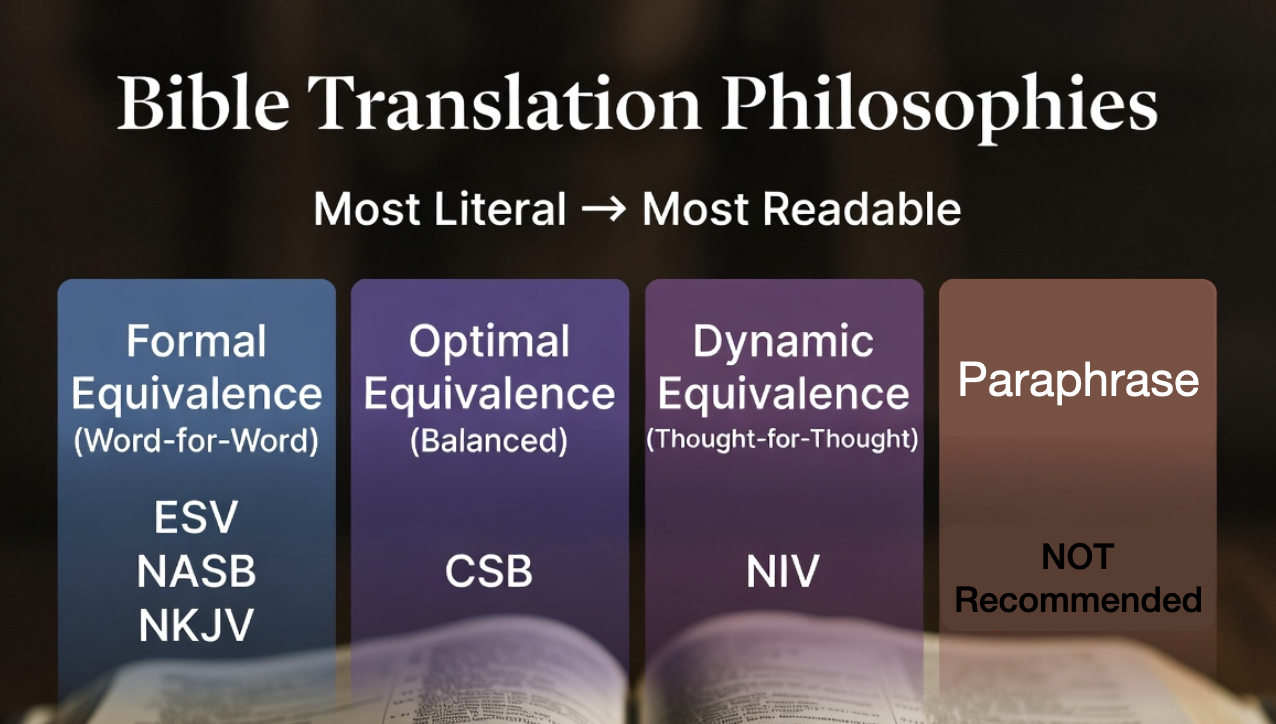
NASB (New American Standard Bible)→ Most literal
ESV (English Standard Version) → Leans literal but still very readable
CSB (Christian Standard Bible) → Most balanced (Optimal)
NIV (New International Version) → Leans more toward readability (Readable)
See the Difference: Real Verse Comparison
The best way to understand each translation is to see the same verse in each one. Here’s John 3:16 side-by-side:
ESV: “For God so loved the world, that he gave his only Son, that whoever believes in him should not perish but have eternal life.”
Feels majestic and great for memorizing.NIV: “For God so loved the world that he gave his one and only Son, that whoever believes in him shall not perish but have eternal life.”
Very clear and natural — easy to understand at a glance.CSB: “For God loved the world in this way: He gave his one and only Son, so that everyone who believes in him will not perish but have eternal life.”
Smooth and conversational — excellent for reading aloud or teaching.NASB: “For God so loved the world, that He gave His only Son, so that everyone who believes in Him will not perish, but have eternal life.”
Extremely precise and literal — ideal if you like digging deep into every word.NKJV: “For God so loved the world that He gave His only begotten Son, that whoever believes in Him should not perish but have everlasting life.”
Poetic and reverent — carries that classic King James feel with updated language.
Seeing the same verse helps you instantly feel which style clicks with you.
Simple Recommendations for Real Life
Just starting out? → Start with the NIV or CSB.
Want one Bible for years? → Choose the ESV or CSB.
Daily devotions or family time → CSB or NIV.
Deeper study or teaching → ESV or NASB.
Helpful Tip: Use the free YouVersion Bible app or Bible Gateway website. You can switch between translations instantly and compare them yourself.
Final Encouragement
The “best” Bible translation is simply the one you’ll open every single day. Don’t overthink it — pick one that feels comfortable, and let God use it to speak to you. Accuracy and readability matter, but consistency matters most.
A Note on the World English Bible (WEB)
On this blog, I often quote from the World English Bible (WEB). Why? It’s a reliable, modern, literal translation that is completely free to use — no copyright restrictions. This allows me to share Scripture openly in every blog post and devotional without any limitations. The WEB is excellent for comparison and wide sharing, but for your personal daily Bible, the ESV, NIV, CSB, or NASB usually feel more polished with better study tools available.
Additional Resources to help you choose
Wesley Huff explores in detail which translation to use
Pastor Josh Howerton ranks Bible translations
Pastor Bobby Gallaty explains & ranks every major Bible translation