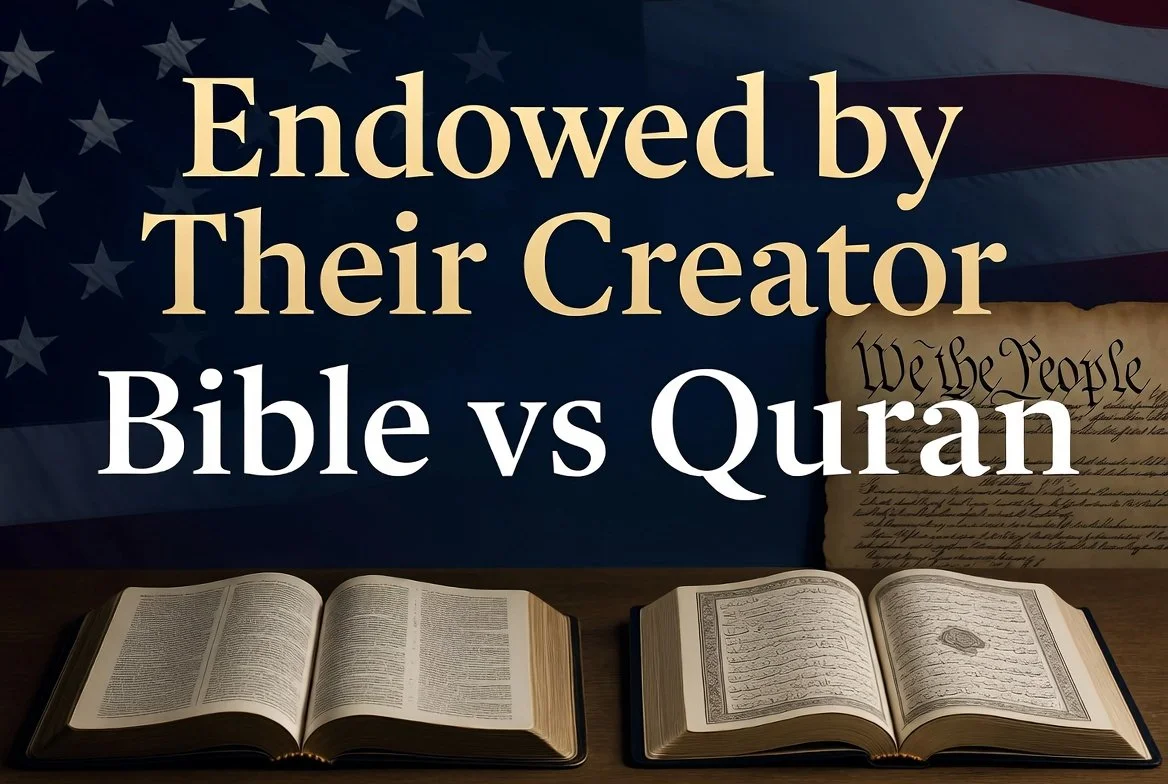
Endowed by Their Creator: Defending Liberty in a Rising Islamic Age
Every Fourth of July, as fireworks light up the sky and families gather in celebration, we return to the words that birthed this nation.
In the Declaration of Independence, Thomas Jefferson declared one of the most revolutionary truths in human history:
“We hold these truths to be self-evident, that all men are created equal, that they are endowed by their Creator with certain unalienable Rights, that among these are Life, Liberty and the pursuit of Happiness.”
“Endowed by their Creator.” Not from government. Not from kings. From God Himself.
These rights are unalienable — permanent gifts because we are made in God’s image. Government’s job is to protect them, not grant or revoke them. This idea became the bedrock of the American Republic.
Yet today, that foundation faces a serious challenge.
The threat of Islam is not only its rapid demographic growth through immigration and higher birth rates. It is the political alliance that protects and accelerates that growth while weakening America’s ability to respond. Radical left and communist ideologies often form a “Red-Green Alliance” with Islamism — using mass migration, identity politics, and cultural guilt as tools against Western civilization, capitalism, and Christianity.
Figures like Zohran Mamdani, a New York socialist politician, exemplify this fusion. He strongly advances socialist policies (such as government healthcare, rent control, and wealth redistribution) while being very vocal in pro-Palestine activism. He takes positions that are soft on radical Islam — meaning he is much quicker to criticize Israel and the West than to strongly condemn Islamist extremism, groups like Hamas, or issues such as Sharia law and grooming gangs. This alliance gives Islam political cover it would never enjoy in a confident Western society.
While some mainstream voices argue that most Muslims are peaceful, fully assimilate, and have no desire to change Western society. History and current patterns from Europe reveal clear challenges: parallel societies, demands for Sharia accommodations, and resistance to full assimilation. The Quran’s explicit commands regarding non-Muslims — including verses that call for their subjugation or conversion; even by force — and Islam’s centuries of expansion add important context that challenges the simplistic “most are peaceful” narrative.
The Unbreakable Foundation — and the Growing Tension
The Bible teaches that God is one God in three persons: Father, Son (Jesus), and Holy Spirit. This relational God enters history in the person of Jesus Christ.
The Quran insists on strict, indivisible oneness (tawhid) and rejects the Trinity as shirk — the sin of associating partners with Allah. However, when the Quran describes what it thinks Christians believe, it portrays the Trinity as Allah, Jesus, and Mary as three gods.
James R. White shows in What Every Christian Needs to Know About the Quran that this is a misunderstanding. Christians have never taught that Mary is part of the Trinity. The Quran appears to critique a distorted or folk version of Christianity rather than historic biblical doctrine.
On Scripture, the Quran claims to confirm the Torah and Gospel but accuses Jews and Christians of corrupting them. White highlights the inconsistency: the Quran tells people in Muhammad’s time to judge by their existing scriptures (Surah 5:47). Historical evidence confirms the Bible’s remarkable textual stability. The Quran’s own transmission involved Uthman’s standardization, during which variant copies were destroyed.
Wes Huff, who has read the Quran multiple times, calls this the “Quranic dilemma.” If the Quran is true, it points back to the uncorrupted Gospel — which then reveals the Quran’s own contradictions. “If the Quran is true, then it’s false.”
Jesus, Salvation, and the Cross
The Bible presents Jesus as the eternal Son of God who died on the cross for our sins and rose again, offering salvation by grace through faith alone (Ephesians 2:8-9; John 3:16). Assurance rests in Christ’s finished work.
The Quran presents Isa as a respected prophet, born of a virgin, but not divine, not the Son of God, and not crucified (Surah 4:157). The Quran offers no historical evidence for denying the crucifixion, which is confirmed by multiple early sources. The Islamic “Jesus” will return not as the biblical King of Kings, but to affirm Islam, break the cross, and establish Muslim dominance.
Salvation in the Quran is works-oriented — judgment by scales of good deeds versus bad, with Allah’s mercy ultimately arbitrary. White’s chapter “The Scales” powerfully contrasts this with the biblical gospel of grace. The Bible offers confident hope rooted in what God has done in Christ — not human effort.
John MacArthur has drawn striking parallels in Islamic eschatology. The Islamic Mahdi (the “guided one,” often identified with the Twelfth Imam) is described as emerging in turmoil, riding a white horse, making a seven-year peace treaty, conquering resisters, and establishing rule from Jerusalem — matching the biblical Antichrist “step-by-step-by-step.” The returning Islamic “Jesus” functions as the biblical False Prophet of Revelation 13. Josh Howerton has called this overlay “mind-blowing.” Revelation 20:4 speaks of Tribulation martyrs beheaded for refusing the mark of the beast — a method of execution prescribed under strict Sharia for apostasy or resistance.
Treatment of Others and the Nature of Law
The New Testament commands us to love our enemies and spread the faith through persuasion, not coercion (Matthew 5:44). The Quran contains verses directing fighting against non-Muslims until they submit or pay the jizya tax (Surah 9:29). Historical Islamic expansion often involved conquest followed by dhimmi status — second-class protection with restrictions. Sharia, derived from Quran and Hadith, is a comprehensive socio-political-legal system governing all of life.
Martin Luther, the German Reformer, viewed the Ottoman Turks (Islam) as a grave threat to Christendom — spiritually, politically, and domestically. He called Islam a “patchwork” of lies that destroys the Gospel, true government, and family life. He saw the Turkish advance as both a call to repentance and a danger requiring resistance and clear refutation.
Islam’s Incompatibility with Core Western Values
Islam is not just a religion but a complete socio-political-legal system. Sharia governs everything. This clashes with the Bible’s influence on the West: separation of religious authority from secular government, individual conscience, equality under law, and free speech.
Western achievements — individual liberty, women’s rights, scientific progress — are fragile and rooted in Judeo-Christian dignity. Quranic teachings on apostasy, blasphemy, gender roles, and non-Muslims create real tensions. The Quran commands fighting People of the Book (Jews and Christians) “until they give the jizya willingly while they are humbled” (Surah 9:29).
British author and commentator Douglas Murray, an atheist who respects Christianity’s role in the West, warns in The Strange Death of Europethat, mass Muslim immigration + loss of civilizational confidence equals cultural suicide. He highlights failed assimilation, grooming scandals, parallel societies, and demographic replacement.
Murray rejects the “religion of peace” narrative as a Western invention:
“The claim that Islam is a religion of peace is a nicety invented by Western politicians… In fact, since its beginning Islam has been pretty violent.”
He warns of Europe’s “existential tiredness” — a willingness to let outsiders rewrite its story. Demographic tipping points, as in Lebanon, erode Western values. Integration is possible for individuals but extremely difficult at scale with unreformed Islam.
This incompatibility is especially clear in America. Our system rests on rights endowed by the Creator — protected by limited government under the Constitution. Islam subordinates all to submission under Sharia. Free speech, reciprocal religious liberty, and equality under law clash with traditional Islamic rulings.
Charlie Kirk has repeatedly and powerfully stated that Islam is incompatible with Western civilization and American values, warning that it is sometimes wielded as a tool against the nation’s identity. Brigitte Gabriel, who survived the Lebanese civil war as a Christian, describes predictable stages of Islamic expansion: infiltration and da’wah when numbers are small; demands for accommodations and parallel societies as numbers grow; political power and cultural dominance; and eventual enforcement of Sharia where critical mass is reached. Her firsthand account of Lebanon’s transformation — from a prosperous, Christian-plurality “Paris of the East” to a failed state under Islamist influence — serves as a stark warning.
Victor Davis Hanson has chronicled centuries of conflict between Islamic empires and the West, noting how unassimilated populations with antithetical values create social tension and erode host civilizations when confidence in Western foundations wanes.
Real-World Patterns
Lebanon: Once over 50-70% Christian at independence (per Gabriel and historical estimates), with Christians holding political preeminence. Palestinian Muslim influx, higher birth rates, and militancy shifted demographics. The 1975–1990 civil war brought targeted violence, massacres, and mass Christian emigration. Today Christians are a shrinking minority (~30-37%) in a Hezbollah-influenced failed state.
United Kingdom: Post-war Muslim immigration with initial assimilation hopes has produced parallel societies, Sharia councils, grooming gang scandals (Rotherham and others, where authorities hesitated due to political correctness), and cultural separation in high-concentration areas.
In the JRE episode #2524 (watch on YouTube or X Post) Rupert Lowe, a British politician, presents a modern example of what happens with large-scale Muslim immigration without real assimilation demands. While some individuals integrate and contribute, group-level patterns in many communities show systematic failures, parallel societies, and direct harm to native populations — especially vulnerable girls. Multiculturalism policies enabled enclaves where British law and norms are secondary.
Key problems in the UK include…
Grooming Gangs and Organized Child Rape: In Rotherham alone, at least 1,400 children (mostly White British girls as young as 11) were groomed, gang-raped, trafficked, beaten, and abused between 1997–2013 by predominantly British-Pakistani Muslim men. Similar scandals hit Rochdale, Telford, Oldham, Huddersfield, and others. Official inquiries found police and councils ignored evidence for years out of fear of being called racist. These scandals continue to be exposed at a national scale. The true number of victims may be as high as 250,000 — a betrayal of vulnerable girls enabled by political correctness and institutional cowardice.
Parallel Societies and “No-Go” Areas: High-concentration Muslim neighborhoods in Bradford, Oldham, parts of Birmingham, Tower Hamlets (London), and elsewhere developed separate norms, high crime, Sharia patrols, and areas where police faced resistance. Outsiders, especially non-Muslims, often feel unwelcome or unsafe. Integration failed — many live in self-segregated enclaves with low intermarriage and parallel economies.
Sharia Councils as Parallel Legal System: Dozens of Sharia councils operate across the UK, handling divorce, inheritance, and family disputes. They frequently discriminate against women. This undermines British law and equality.
Visible Non-Assimilation and Cultural Separation: Widespread hijab and niqab in some communities serve as markers of distinct identity. Polls have shown significant support among British Muslims for aspects of Sharia. This creates visible parallel societies that resist full blending into British culture.
The United States remains earlier in this trajectory, but the same dynamics — demographic growth without robust assimilation, ideological supremacism in classical sources, and demands for accommodations — are observable.
“We the People” Are Not Spectators
The Bible warns of deception in the last days (Matthew 24:24; 2 Thessalonians 2:3-4), yet it offers ultimate hope in Christ’s victory.
America’s Founders assumed a predominantly Christian moral culture to sustain liberty. They did not envision large-scale importation of an ideology that denies the Creator who endowed our rights.
“We the People” are not spectators — we are the guardians.
Every Independence Day, let us renew the covenant: secure liberty for our children, defend the Constitutional Republic with courage, and prove once more that a nation conceived in liberty can endure if we choose to keep her.
Study the texts. Engage with clarity and grace. Pray for discernment and revival. Evangelize with the true gospel. Advocate for policies that preserve ordered liberty and demand genuine assimilation.
The choice before us is not between tolerance and bigotry. It is between two irreconcilable visions of reality — one rooted in the Creator who gives unalienable rights, and one that demands total submission to a different law.
May we choose wisely, courageously, and faithfully.