Bravery in the Bible: Untamed Stories of Courage That Still Inspire Today
Most of the bravery in the Bible looks nothing like the version we usually picture. It is not the person who feels no fear and charges ahead. It is the person who feels the fear clearly, has no guarantee the story will end the way he hopes, and still takes the next step because he trusts the One who holds the outcome.
Joshua needed to hear “be strong and courageous” three times in a row. The three young men in Babylon answered a king with “our God is able… but if not.” Esther walked into a throne room that could have cost her life and said, “If I perish, I perish.” Jesus asked for the cup to pass and then stood up and walked toward it. The pattern is consistent. Courage in these accounts is not the disappearance of fear. It is obedience that keeps moving while the fear is still present.
The stories that follow show what that actually looked like.
David and Goliath: The Slingshot That Changed Everything
The Philistine giant Goliath stood in the Valley of Elah day after day, taunting the armies of Israel and defying the living God. The entire Israelite army, including King Saul, was terrified. No one would fight him.
Then a young shepherd named David arrived. When he heard Goliath’s blasphemy, he asked, “Who is this uncircumcised Philistine, that he should defy the armies of the living God?” David volunteered to fight.
Saul doubted him because of his youth, but David replied with quiet confidence rooted in past experience with God:
“David said, ‘The LORD, who delivered me out of the paw of the lion and out of the paw of the bear, will deliver me out of the hand of this Philistine.’” (1 Samuel 17:37).
Refusing Saul’s armor, David took only his staff, five smooth stones, and his sling. As he approached Goliath, the giant mocked him. David answered:
“Then David said to the Philistine, ‘You come to me with a sword, with a spear, and with a javelin; but I come to you in the name of the LORD of Armies, the God of the armies of Israel, whom you have defied. Today, the LORD will deliver you into my hand. I will strike you and take your head from off you. I will give the dead bodies of the army of the Philistines today to the birds of the sky and to the wild animals of the earth, that all the earth may know that there is a God in Israel, and that all this assembly may know that the LORD doesn’t save with sword and spear; for the battle is the LORD’s, and he will give you into our hand.’” (1 Samuel 17:45-47).
David ran toward the giant, loaded his sling, and struck Goliath in the forehead. The stone sank in, and the giant fell face-down. David then used Goliath’s own sword to finish the victory.
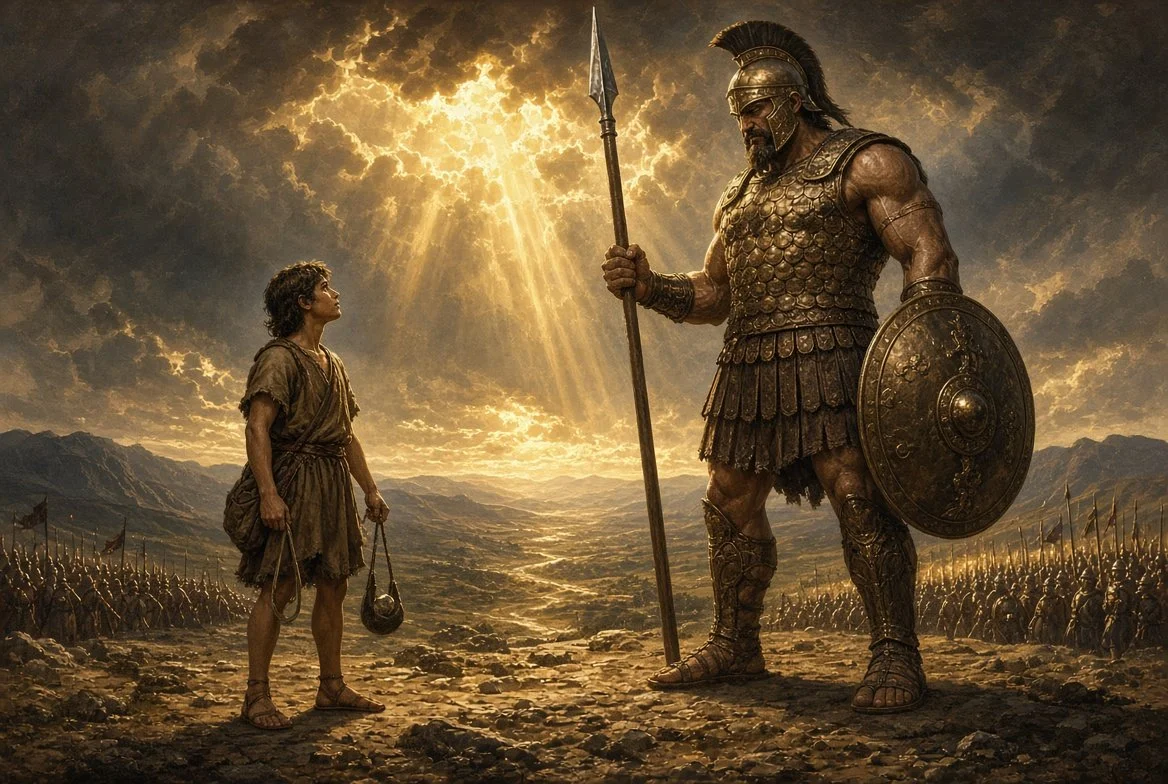
David & Goliath
David’s bravery was not reckless confidence in himself. It was complete trust that the battle belonged to God.
Furnace Faith and Lion-Den Legends
Fast-forward to Babylon. King Nebuchadnezzar builds a massive golden image and commands everyone to bow down and worship it. Anyone who refuses will be thrown into a blazing furnace. Three young Jewish men — Shadrach, Meshach, and Abednego — refuse.
When the king confronts them, they answer with one of the boldest statements of faith in all of Scripture:
“If it happens, our God whom we serve is able to deliver us from the burning fiery furnace; and he will deliver us out of your hand, O king. But if not, let it be known to you, O king, that we will not serve your gods or worship the golden image which you have set up.” (Daniel 3:17-18).
They are thrown into a furnace heated seven times hotter than usual — so hot it kills the soldiers who carry them in. Yet they walk out unharmed, without even the smell of fire on them.
Later, Daniel shows the same unshakable courage. He keeps praying to God with his windows open toward Jerusalem, even after a royal decree makes it illegal. He is thrown into a den of lions… and spends the night unharmed.
In both stories, their bravery wasn’t based on guaranteed rescue. It was rooted in loyalty to God no matter the outcome.
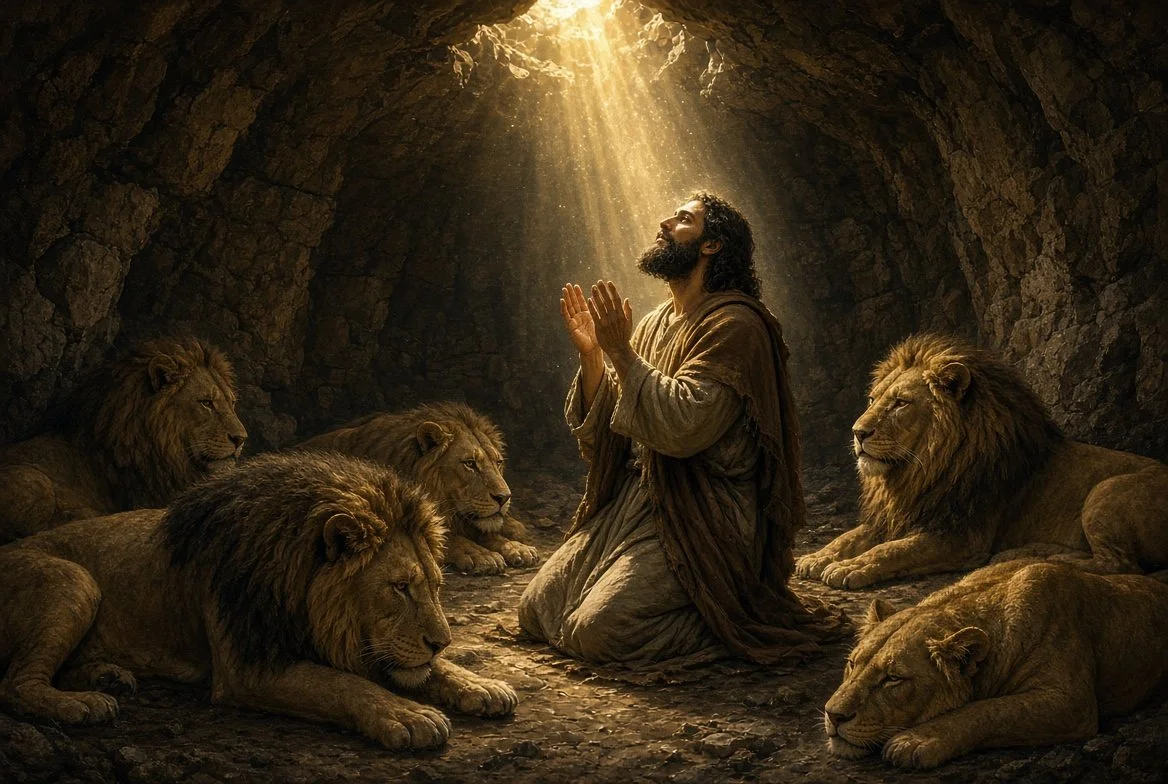
Daniel in the lions’ den
The Queen Who Risked Everything and the King Who Faced the Cross
Queen Esther learned that Haman had engineered a royal decree to destroy all the Jews in the Persian Empire. Going before King Ahasuerus without being summoned was punishable by death. After fasting and prayer, Esther made her decision:
“Go, gather together all the Jews who are present in Susa, and fast for me, and neither eat nor drink three days, night or day. I and my maidens will also fast the same way. Then I will go in to the king, which is against the law; and if I perish, I perish.” (Esther 4:16).
She risked everything — and God used her courage to save her people.
The ultimate example of bravery is Jesus Himself. In the Garden of Gethsemane, knowing the full weight of the cross that lay ahead, He prayed in deep agony:
“‘Father, if you are willing, remove this cup from me. Nevertheless, not my will, but yours, be done.’… Being in agony, he prayed more earnestly. His sweat became like great drops of blood falling down on the ground.” (Luke 22:42, 44)
Fully aware of the coming scourging, nails, and separation from the Father, Jesus still chose the path of obedience and love.
Apostles Who Went From Locked Rooms to Unstoppable
After Jesus’ crucifixion, the disciples locked themselves in a room out of fear. The resurrection changed everything. Empowered by the Holy Spirit at Pentecost, the same men who had fled now stood publicly and preached Christ with boldness — even when threatened by the religious authorities.
When Peter and John were ordered to stop speaking in Jesus’ name, the early church prayed:
“Now, Lord, look at their threats, and grant to your servants to speak your word with all boldness,… When they had prayed, the place was shaken where they were gathered together. They were all filled with the Holy Spirit, and they spoke the word of God with boldness.” (Acts 4:29, 31)
They went from hiding behind locked doors to filling Jerusalem with the message of the risen Christ, willingly facing imprisonment, beatings, and eventually martyrdom. Their courage was not self-generated — it flowed from the reality of the resurrection and the power of the Holy Spirit.
Our Turn: Living Out Bravery in the Bible Today
God’s command still rings clear:
“Haven’t I commanded you? Be strong and courageous. Don’t be afraid. Don’t be dismayed, for Yahweh your God is with you wherever you go.”
“Be strong and courageous. Don’t be afraid or scared of them, for Yahweh your God himself is who goes with you. He will not fail you nor forsake you.”
“Watch! Stand firm in the faith! Be courageous! Be strong!”
Bravery in the Bible isn’t reserved for ancient heroes. It’s the quiet “yes” when sharing our faith feels awkward, standing for truth costs popularity, or simply refusing to quit when life hits hard. Fear may knock. Courage answers the door and walks out anyway — because the God who was with David, Daniel, Esther, Jesus, and the apostles is with us.
So what’s your next brave step? The story is still being written. Lace up. Say yes. The adventure is waiting — and it’s better than any movie.