Is the Bible Trustworthy?
A Comprehensive Deep Dive into the Evidence for Scripture’s Reliability
What if the book many dismiss as outdated, unreliable, or even harmful turned out to be the most trustworthy document in human history?
In an era of skepticism, viral deconstruction stories, and competing worldviews, the question remains as urgent as ever: Can we really trust the Bible? Is it the inspired, authoritative Word of God, or a flawed collection of ancient writings shaped by human agendas, later edited, and filled with “lost” alternatives?
A lot is at stake… Jesus said it Himself in John 14:6: “I am the way, the truth, and the life. No one comes to the Father, except through me.”
If the Bible is NOT God’s Word, then no problem. BUT if it is God’s Word, just as the Bible states it is, then we may want to believe in Jesus Christ and pray to God for His Grace and the change of heart by the Holy Spirit.
Read It… you have nothing to lose, but everything to gain!
The Bible boldly declares its divine origin:
2 Timothy 3:16-17: “Every Scripture is God-breathed and profitable for teaching, for reproof, for correction, and for instruction in righteousness, that each person who belongs to God may be complete, thoroughly equipped for every good work.”
God-breathed - means that the words that God put to the authors’ hearts and minds were inspired by God. Words that were dictated by God to the authors.
2 Peter 1:20-21: “knowing this first, that no prophecy of Scripture is of private interpretation. For no prophecy ever came by the will of man, but holy men of God spoke, being moved by the Holy Spirit.”
The Holy Spirit superintended the authors — every word in the original manuscripts was breathed out by God while preserving each writer’s unique personality and style.
The Proof of Trustworthiness
1. Discovery
Manuscript Evidence: The Best-Preserved Text in Antiquity
Volume: Approximately 25,000+ handwritten copies of the New Testament (including ~6,000 Greek); within decades after the original, witnesses still alive. This dwarfs other ancient works:
Homer’s Iliad - ~1,800 copies with larger time gaps.
Ceasar’s “Gallic Wars” - 10 copies, 900 years after the original.
Oxyrhynchus discoveries (late 1800s–early 1900s): Over half a million papyri fragments, including biblical texts. One standout is 𝔓1 (P1), a late 2nd/early 3rd-century fragment of Matthew’s Gospel found literally sticking out of the sand.
Dead Sea Scrolls, discovered 1947: copy of every Bible book, except of the Book of Esther. Confirm Old Testament stability over a millennium with only minor differences.
Wes Huff emphasizes that Egypt’s dry climate preserved thousands of early papyri. Most of our earliest New Testament manuscripts come from there, not Israel.
Huff stresses that textual variants exist — but the vast majority are minor (spelling, word order, scribal slips). The abundance of copies actually helps scholars reconstruct the original text with ~99.5%+ accuracy in meaning. No core Christian doctrine depends on a disputed variant.
Lee Strobel’s research in The Case for Christ reached the same conclusion: the New Testament’s textual transmission is the strongest of any ancient document.
2. Chronology
Unity and Coherence Across Time: The Impossible Harmony of 40 Voices
One of the most compelling evidences for the divine origin of the Bible is its astonishing unity despite extreme diversity.
The Bible was written by ~40 different authors over a span of 1,500+ years, on three continents (Asia, Africa, and Europe), in three languages (Hebrew, Aramaic, and Greek).
Its writers were kings, shepherds, fishermen, a tax collector, a doctor, and even a former persecutor of Christians. Yet it presents one unified redemption story: creation, the fall, God’s covenant with Israel, and fulfillment in Jesus Christ.
These authors lived in vastly different historical contexts — some during times of prosperity and kings, others during exile, slavery, or Roman occupation. Most never met one another. Many never read the writings of those who came before them. Yet they produced one unified, breathtaking story without contradiction on its central story — of God who loves His broken creation enough to redeem it through His Son, Jesus Christ.
The entire book tells one united story. It’s all connected together. That kind of harmony across such vast differences isn’t just impressive. It’s miraculous.
To visualize this miracle, there are 63,779 documented connections.
You will not find another book in all of human civilization with this kind of unity. The only satisfying answer is divine authorship.
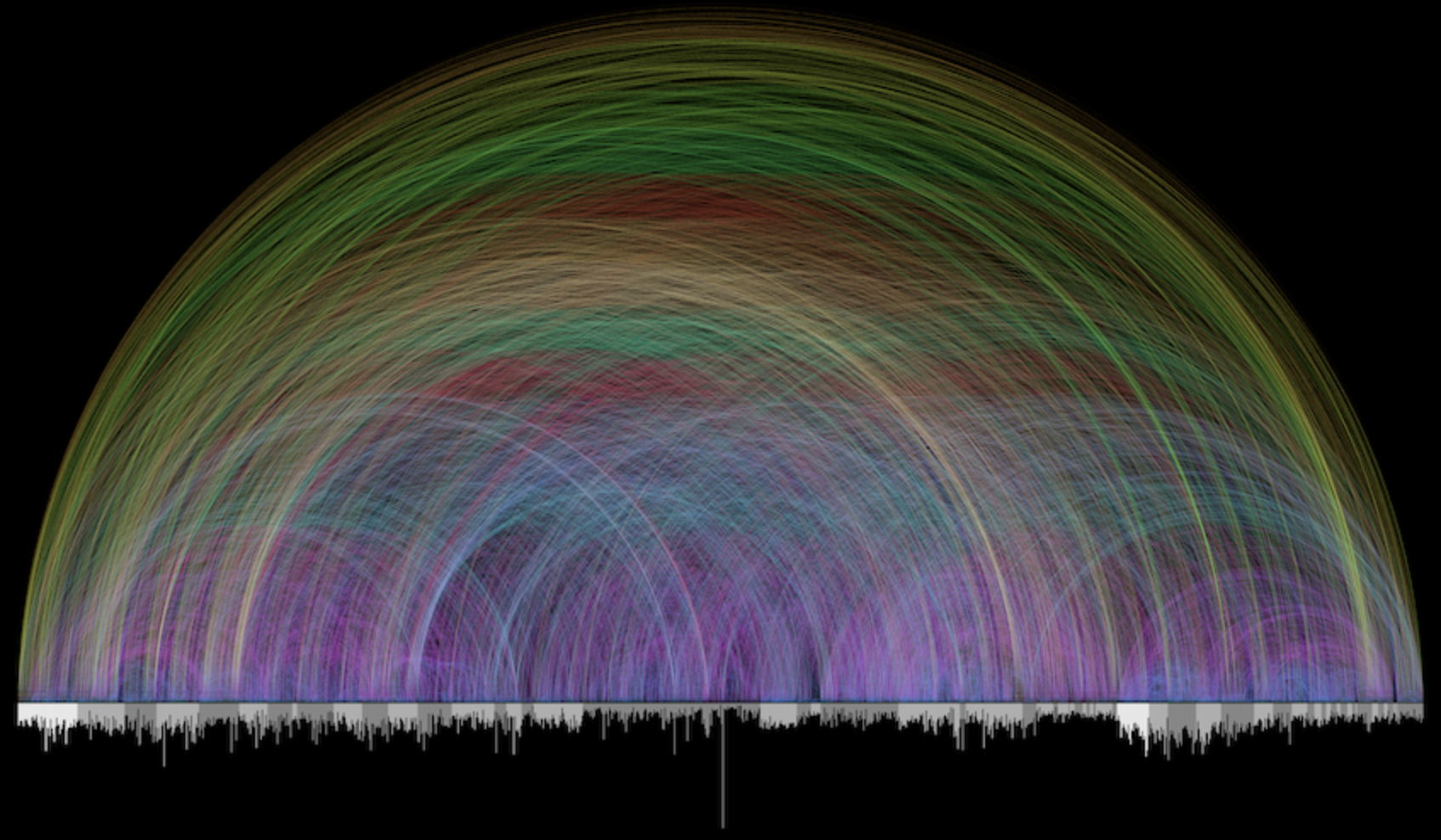
The image looks like a vast, intricate web or neural network, with thousands of lines linking verses, chapters, and books across the Old and New Testaments.
Think about the improbability:
40 authors could easily have produced 40 competing or contradictory stories.
Instead, Genesis lays the foundation, the Law and Prophets build expectation, the Gospels record fulfillment, Acts shows the message spreading, the Epistles explain its meaning, and Revelation completes the story.
Themes of sin, sacrifice, covenant, justice, mercy, and salvation weave seamlessly from the first page to the last. The Old Testament points forward to Jesus; the New Testament looks back to Him and forward to His return.
As Pastor Bobby Gallaty concludes while pointing to the cross-reference graphic: “This is the handiwork of God… You find me another book in all of human civilization [like this]. The only answer for this is God. Period.”
This level of coherence is humanly impossible. It is exactly what we would expect if one sovereign Mind — the Holy Spirit — inspired every human writer while preserving their unique voices and perspectives.
3. Prophecy
Fulfilled Prophecy: Far Beyond Chance
The Bible records over 2,500 prophecies, with ~2,000 fulfilled and ~500 yet to come. Many center on the Messiah.
Pastor Robby Gallaty lists these key examples about Jesus:
He would be born in Bethlehem (Micah 5:2) - predicted 700 years before Jesus was born
He would be born of a virgin (Isaiah 7:14)
Taken to Egypt as a child (Hosea 11:1)
Triumphal entry into Jerusalem on a donkey (Zechariah 9:9)
Betrayed for 30 pieces of silver (Zechariah 11:12)
Crucifixion details (Psalm 22; Zechariah 12:10) - 400 years before crucifixion was invented
Teaching in parables (Isaiah 6:9-10)
Proclaiming liberty to captives (Isaiah 61:1)
Peter Stoner’s classic calculation in Science Speaks: the odds of one person fulfilling just eight of these prophecies by chance are 1 in 10¹⁷ — illustrated by covering Texas in silver dollars two feet deep and picking the marked one blindfolded on the first try.
Archaeology and external sources further corroborate the Bible’s historical reliability.
The Bible’s Impossible Origin Story
66 books (39 in the Old Testament, 27 in the New)
Forty authors.
1,500+ years.
Three continents (Asia, Africa, Europe).
Three languages (Hebrew, Aramaic, Greek).
The Bible is not a science book, not astrology book, not biology book, not a book on how to get rich… It’s a love letter from God to us about how we can have a personal relationship with Him through His Son, Jesus Christ.
What makes this origin story truly impossible is the astonishing unity that emerges from such extreme diversity. Forty authors from vastly different times, cultures, and walks of life somehow produced one seamless redemption story — from creation and the fall, through God’s covenant with Israel, to its fulfillment in Jesus Christ and final victory. The Old Testament points forward to Jesus; the New Testament looks back to Him and forward to His return. That kind of harmony across 1,500+ years is humanly improbable. It is exactly what we would expect if one sovereign Mind — the Holy Spirit — inspired every writer while preserving their unique voices.
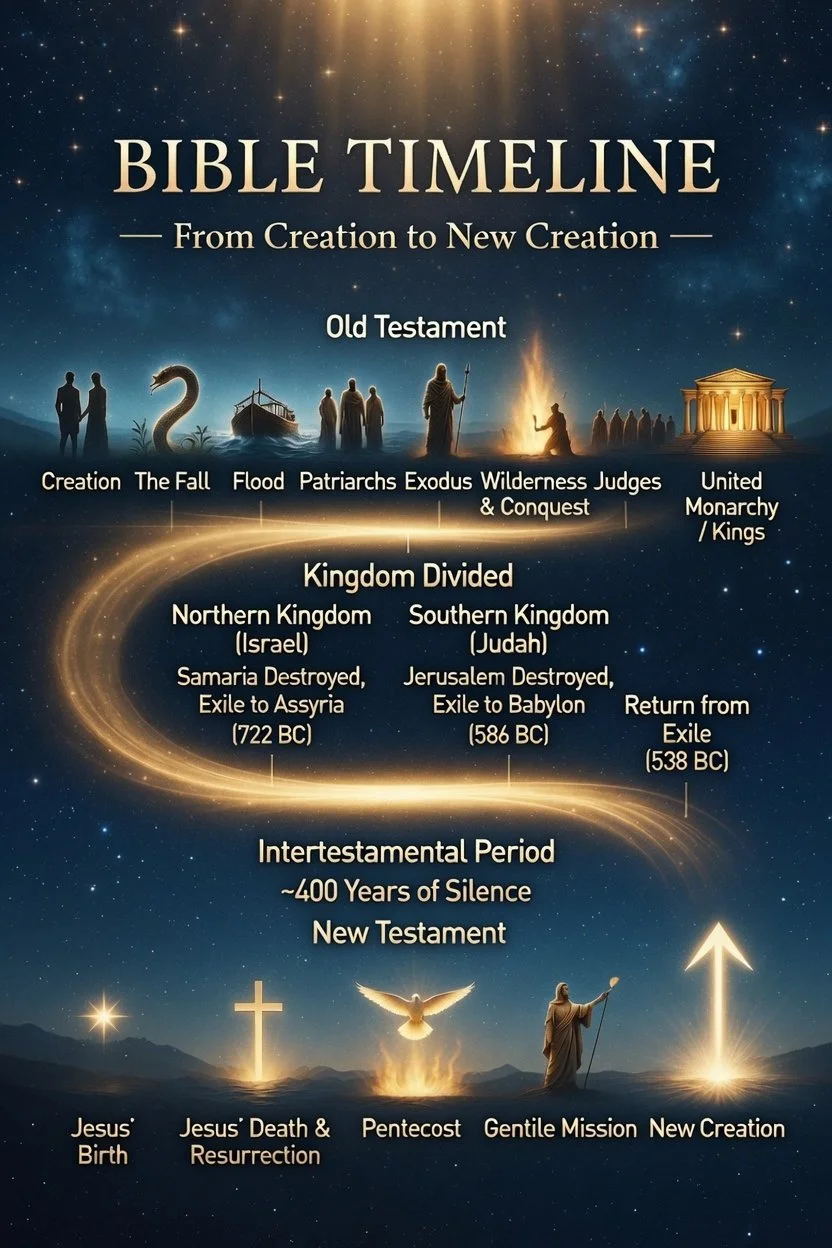
Bible Timeline
As Wes Huff explains in Episode 1 “The Right Books” (Can I Trust the Bible? - series), early Christians did not “vote” on the canon at some later council. They recognized writings that carried inherent apostolic authority — those directly linked to Jesus and His eyewitnesses or their close associates (the apostolic fathers). The New Testament books emerged naturally as the community identified texts that aligned with the teachings of Jesus and the apostles.
Huff addresses popular myths about “lost gospels.” In 1945, near Nag Hammadi in Egypt, a farmer uncovered a jar containing Gnostic texts, including the Gospel of Thomas. These documents, written centuries later, were not suppressed orthodox writings but later pseudepigraphal works. Gnostic groups often attached apostolic names (Thomas, Peter, Mary) to lend credibility to their teachings, which differed sharply from the historical, incarnational gospel. The early church rejected them because they lacked connection to the eyewitness community around Jesus.
The Old Testament canon was already largely settled for first-century Jews, who viewed their Scriptures as anticipating the Messiah. The New Testament completes that story.
Why This Matters Today
As Huff concludes after examining manuscripts in Egypt, discoveries do not distance us from the original text — they bring us closer. The Bible we hold is faithfully transmitted from the eyewitness accounts.
The Challenge: Read it yourself. Start with the Gospels. Examine the evidence. Pray for understanding.
As Huff reminds us, we are not relying on “translations of translations of translations” in a telephone game — modern translations work directly from the best available ancient Hebrew and Greek texts, informed by abundant manuscript evidence.
The cumulative case — right books (recognized apostolic authority), right text (faithfully copied), internal unity, fulfilled prophecy, and life-changing power — makes a robust defense. You can trust the Bible.
This post was inspired by Pastor Robby Gallaty’s sermon (watch here) and Wesley Huff’s Can I Trust the Bible? series (series on wesleyhuff.com).