You didn’t pick up Marx. You noticed the rent. You watched a hospital bill turn into a second job. You worked full-time and still felt like inventory. The person who owns the building talks about personal responsibility as if the building appeared out of thin air. That anger is not fake. A wage can function as a leash. A landlord can hold a life by a piece of paper. These are real powers, and the people who deny them are rarely the ones living under them.
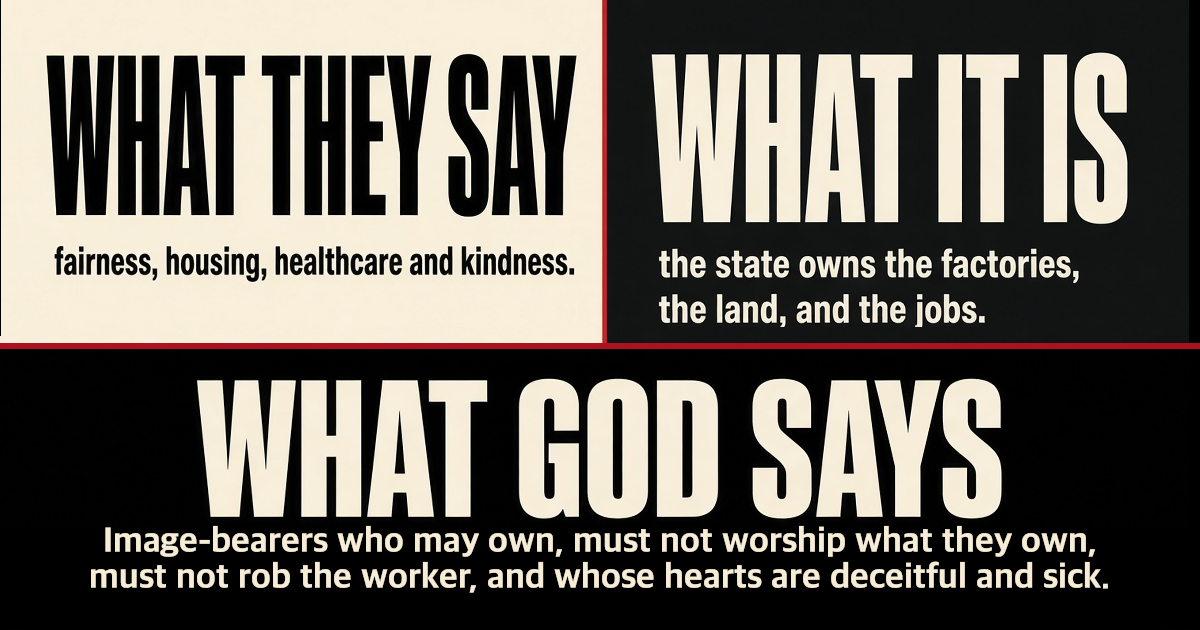
Then someone offers a word: socialism. Housing you can afford. A doctor you can see. A boss who cannot treat you like a faucet.
That is the bait.
Two Different Projects Share One Word
The package being sold is not socialism. It is a moral protest wearing a label most people have never been forced to define. Polls show large numbers of young Americans favorable toward “socialism,” and a surprising number toward “communism.” The questions almost never define the terms. A generation can love the label and still be wrong about the object.
Socialism, in the sense that actually built parties and states, is social ownership of the means of production — land, factories, capital, the major industries — taken out of private hands, by force if necessary, and held by the state, the party, or “the people” as administered by people with a police force.
Marxism is that claim plus a story: class is the engine of history, private property is the original wound, and revolution is the surgery.
“Tax the rich, keep the shop, keep the vote, and run a generous welfare state” is something else. Sweden is something else. Your aunt meaning Medicare and fewer slumlords is something else. Most people who call themselves democratic socialists today are not proposing to abolish private ownership of factories, farms, and jobs and hand them to a single political apparatus. They are proposing social democracy — heavy redistribution and regulation inside a market system. Those systems have real costs and trade-offs: housing shortages under strict rent control, slower growth, taxes that hit more than the rich. They are not the same project as the one that put the party in charge of the economy and treated disagreement as sabotage.
The useful lie is that the two things share one word. If socialism means basic decency, only a monster would oppose it. If it means who owns the tools and what happens to the person who will not surrender them, you are in a different argument. Most of the warmth around the word depends on never having that second conversation.
Keep the Anger, Drop the Costume
The anger underneath is often telling the truth. Fight the leash. Build enough housing that a landlord cannot treat a human like a faucet. Break monopolies. Pay people. None of that requires you to accept the system hiding behind the slogan.
The Real Claim
Work creates most of what exists. Most people do not own the tools that work requires. They sell hours to live. The owner keeps what those hours produce beyond the wage. Marx’s answer is simple: change who owns the tools and you change what people are. The person who will not join is not a neighbor in the way. They are an obstacle.
Has any group, once it held both the tools and the guns, stopped acting like a class with interests of its own? The theory needs the answer to be yes.
If the impulse to protect status and power is created only by private property, removing private property should remove it. If that impulse is older than private property — and every society on record suggests it is — then removing private property simply hands it a monopoly. The administrators become the new owning class, whatever they call themselves. Concentrated power does not vanish because the letterhead says “workers’ state.”
What Happened When the Word Had Power
Then look at the countries that tried the real thing — not the slogan. Not Sweden. The places that put the factories, the land, and the jobs in the party’s hands and treated disagreement as a threat.
When those places turned cruel or poor, the excuses arrive in a set…
It was too early. Russia and China were peasant countries, so the disaster does not count.
They were surrounded. War and isolation caused the camps and the shortages, not the system.
That wasn’t real socialism. Real socialism would have been kind and abundant; therefore whatever happened was a fake.
The government was supposed to shrink. Instead it grew. So the growth was a betrayal, not what the theory built.
The officials stole it. A caste of bureaucrats sat on the workers; blame them, keep the idea.
Some of those facts are real. Russia was poor. The USSR was invaded. Officials did live better than workers. None of them explain why the pattern repeated across different countries, different decades, and different leaderships once the same structural move was made: one political center controlling the means of production and the means of coercion.
The question is what the excuses are doing. They define socialism as only the good ending. As soon as a state owns the tools and starts eating people, it gets renamed. The word stays innocent. The bodies get filed under “not the real thing.”
Power and Information Do Not Disappear
If one party owns the factories, the food, and the jobs, the people who allocate them are the new owning class. A central apparatus also cannot gather and process the dispersed information that markets generate through prices and the ability to leave. When it is wrong, there is nowhere else to go.
If the idea only works with no enemies, no hunger, no ambitious officials, and no one who refuses to join, it is not an idea for the world we live in. That world always has those.
I lived where the word was not a campus mood. Power was abused in ordinary rooms. Poverty was empty shops and fear of the wrong opinion. What gets sold here as socialism was not what I saw.
A Constraint Older Than the Word
You do not have to believe the Bible is true to notice that it named a real limit before Marx named a bourgeoisie. It says every person is made in God’s image — owner and hired worker. It says the fracture began when people reached for God’s place and then hid, blamed, and dominated. It says all have sinned, which means your side does not become holy by winning.
A politics that locates evil only in the other camp will eventually need permission to be cruel to that camp. A view that locates the problem in the human heart puts limits on kings, crowds, and revolutionaries alike. Something can belong to someone. The poor have a claim. Do not cheat wages or rig the court. In Acts, believers sold land until nobody was needy. Concentrated power needs limits because the heart does not wash clean when the keys change hands.
Two Sentences, Not One Word
Two sentences get taped together and sold as one word. Only one of them is worth keeping.
You can hate contempt for the weak without signing up for the rest of the package. The slogan takes the first part. The system needs the second: the state owns the tools, and anyone who refuses to go along becomes a problem rather than a neighbor.
That is the difference. One sentence is a moral claim most people already accept. The other is a political project that has to treat disagreement as sabotage. They are not the same thing.