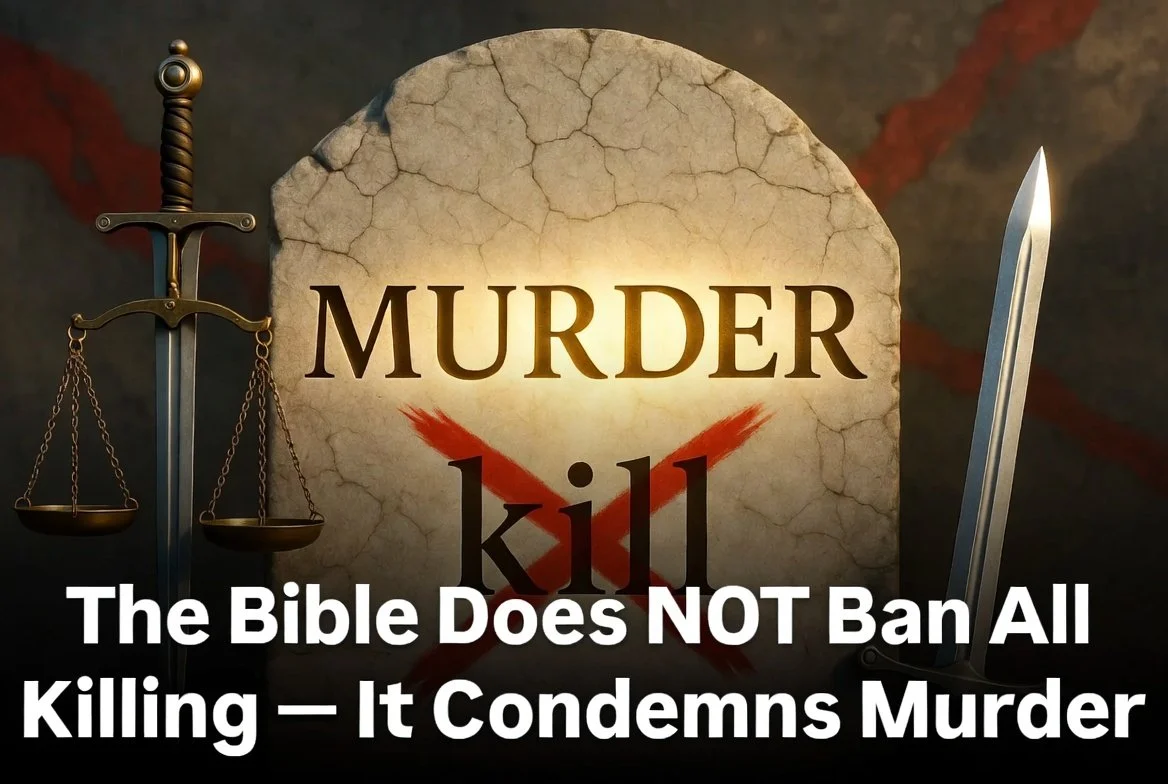
21 Myths Series: Myth 9 — Does the Bible Prohibit All Killing?
Sexuality, Slavery & Moral Myths (Myths 6–10)
Does the Bible Prohibit all Killing? Addressing Hot-Button Moral Myths
Myth 9: “Thou shalt not kill” is a blanket prohibition (e.g., against all war or capital punishment).”
One of the most repeated claims about the Bible is that the Sixth Commandment — “Thou shalt not kill” — demands absolute pacifism and prohibits the death penalty. This myth fuels modern debates on war, criminal justice, and self-defense. But is it accurate?
Short answer: No. The original Hebrew does not support a total prohibition on taking life. Properly understood, the commandment condemns murder while upholding justice, legitimate authority, and the protection of innocent life.
The Hebrew Distinction: Murder, Not All Killing
The King James Version’s familiar phrasing “Thou shalt not kill” (Exodus 20:13; Deuteronomy 5:17) is a broad translation that has caused centuries of confusion. The Hebrew verb ratsach (רָצַח) specifically means unlawful, premeditated, or malicious killing of an innocent person — what we call murder. Hebrew uses different words for general killing (harag) or judicial execution (muth).
This distinction appears clearly in Numbers 35:16–21, which describes various forms of murder and mandates the death penalty for them. Ratsach never applies to:
Judicial execution by legitimate authority
Self-defense
Just war authorized by God or government
Modern translations get it right: “You shall not murder” (NIV, ESV, CSB, NKJV, etc.).
Biblical Support for Justice and Just War
The Bible consistently distinguishes unlawful murder from sanctioned taking of life:
Capital Punishment
Genesis 9:6 establishes the principle early:
“Whoever sheds man’s blood, his blood will be shed by man, for God made man in his own image.”
This upholds the sanctity of life by requiring justice for murderers. The same law code that says “do not murder” commands the death penalty for murder and other crimes (Exodus 21:12–14; Leviticus 24:17; Numbers 35).
Just War and Self-Defense
God directly commanded Israel to engage in defensive and conquest wars (Deuteronomy 7 & 20, Joshua, Judges). Soldiers killing in battle or citizens defending life are not murderers. Romans 13:1–4 describes government as God’s servant bearing “the sword” — a clear symbol of lethal force — to punish evil and protect the innocent.
Old Testament examples: Many divinely sanctioned killings occur without violating the commandment.
Key Quote
John MacArthur: “Thou shalt not kill” means “Do not murder.” It does not refer to capital punishment (taken under divine allowance) or just war.
The Bible does not condone sin — it condemns murder while upholding justice. This commandment protects the vulnerable and calls societies to value life without anarchy.
Why This Matters
Misunderstanding this commandment creates several problems:
It leads people to claim all war is immoral or the death penalty is “unbiblical.”
It creates a false contradiction between the Old and New Testaments.
It undermines the Bible’s high view of human life: because every person bears God’s image, murder is a profound evil that deserves justice.
A proper reading allows us to be both pro-life (protecting the innocent) and supportive of just capital punishment (for the guilty, when rightly administered).
Charlie Kirk often highlights the Torah’s logic: God values human life so highly that unlawfully taking it demands the ultimate penalty.
Conclusion
The Sixth Commandment does not demand absolute pacifism or ban all taking of life. It powerfully condemns murder while upholding justice, legitimate authority, and the sanctity of innocent life. Far from portraying God as capricious, this commandment reflects His perfect balance of mercy and justice.
In a world facing rising violence, terrorism, and heated criminal justice debates, this biblical clarity equips us to value every human life without enabling evil or anarchy. The Bible does not condone sin — it condemns murder and calls societies to protect the vulnerable while punishing the guilty.
God’s character remains consistent: He hates the shedding of innocent blood and demands justice for those who shed it.
This is Myth 9 in my 21 Myths Series: Hot-Button Moral Myths (Myths 6–10).
Previous:
Myth 6 — Does the Bible Condemn Homosexuality?
Myth 7 — Does the Bible Support Slavery?
Myth 8 — Is the OT God Angry and the NT God Loving?
Reliable Voices on This Topic
John MacArthur / Grace to You (gty.org): Sermons like “Who Is a Murderer?” (Matthew 5) directly address the distinction.
Charlie Kirk: Public discussions on the Torah and death penalty.
Josh Howerton: Teachings on being pro-life and supporting just capital punishment.
Wes Huff: Apologetics addressing Bible myths, including violence and commandments.
Martin Luther: Large/Small Catechisms (context of the commandments).
Lee Strobel: Investigative work on biblical justice and the crucifixion.