What Is the Meaning of the Parable of the Sower?
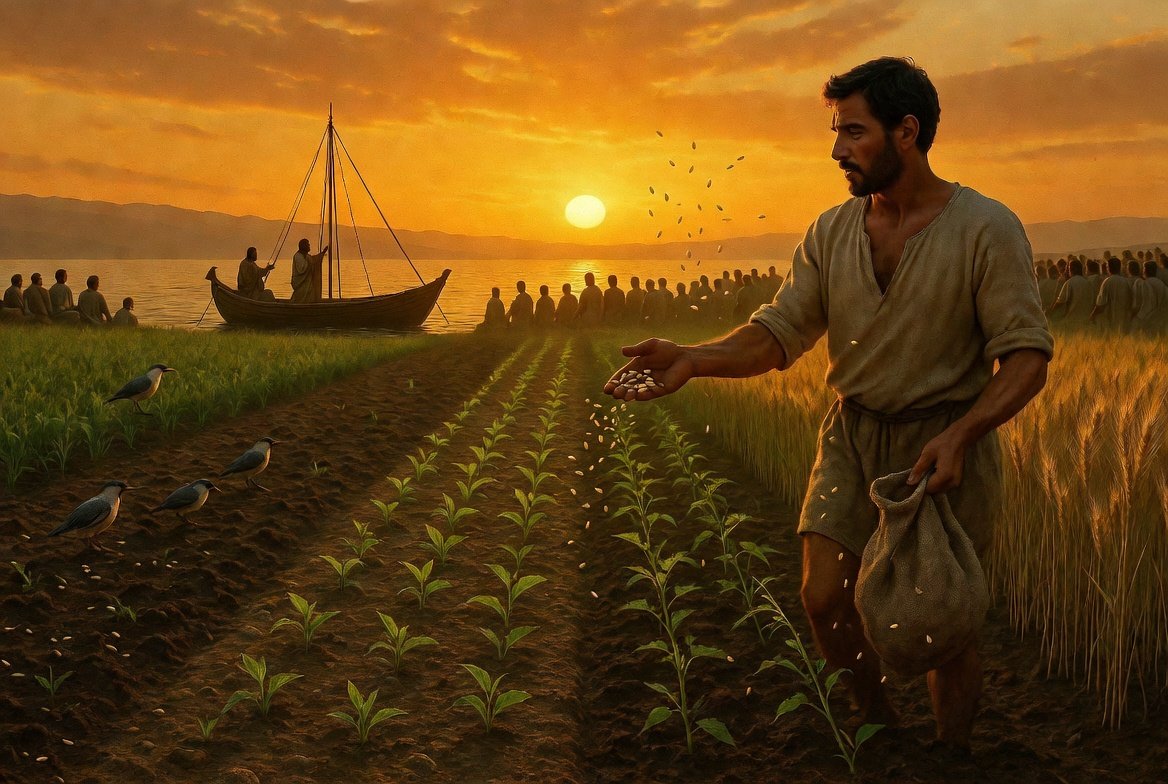
Imagine standing on the shore of the Sea of Galilee at sunset. Crowds press forward, hungry for hope. A man steps into a fishing boat, sits down, and begins to speak — not with thunder, but with a simple story about a farmer and some seeds.
That man was Jesus.
The story He told that day has been diagnosing human hearts for two thousand years.
Early in His ministry, opposition was rising and crowds were gathering for miracles that often left them unchanged. So Jesus told this parable to reveal who was truly listening.
A farmer walks out at dawn, seed bag over his shoulder, and scatters seeds generously. Some fall on the hard path and birds snatch them. Some land on rocky ground, spring up quickly, then wither. Some fall among thorns and are choked. But some sink into good soil and yield a harvest — thirty, sixty, even a hundredfold.
This parable is not primarily about the farmer or the seed. It’s about the soil.
And the soil… is you.
In a noisy world of quick spiritual highs and endless distractions, the same message transforms one person and bounces off another. The difference is the condition of the heart. Jesus, the Master Gardener, can still transform even the hardest ground.
The Full Story, in Jesus’ Own Words
Matthew 13:1-9
“On that day Jesus went out of the house and sat by the seaside. 2 Great multitudes gathered to him, so that he entered into a boat and sat; and all the multitude stood on the beach. 3 He spoke to them many things in parables, saying, ‘Behold, a farmer went out to sow. 4 As he sowed, some seeds fell by the roadside, and the birds came and devoured them. 5 Others fell on rocky ground, where they didn’t have much soil, and immediately they sprang up, because they had no depth of earth. 6 When the sun had risen, they were scorched. Because they had no root, they withered away. 7 Others fell among thorns. The thorns grew up and choked them. 8 Others fell on good soil and yielded fruit: some one hundred times as much, some sixty, and some thirty. 9 He who has ears to hear, let him hear.’”
Matthew 13:18-23 (explanation section)
“‘Hear, then, the parable of the farmer. 19 When anyone hears the word of the Kingdom and doesn’t understand it, the evil one comes and snatches away that which has been sown in his heart. This is what was sown by the roadside. 20 What was sown on the rocky places, this is he who hears the word and immediately with joy receives it; 21 yet he has no root in himself, but endures for a while. When oppression or persecution arises because of the word, immediately he stumbles. 22 What was sown among the thorns, this is he who hears the word, but the cares of this age and the deceitfulness of riches choke the word, and he becomes unfruitful. 23 What was sown on the good ground, this is he who hears the word and understands it, who most certainly bears fruit and produces, some one hundred times as much, some sixty, and some thirty.’”
Kingdom Parable
This parable launches Matthew 13’s “kingdom parables.” It explains why the long-awaited King was being rejected even as crowds flocked to Him.
Walk the Field
Central Message: Your response to God’s Word reveals the true condition of your heart — and only a transformed heart can produce lasting fruit.
The Sower and the Seed: The sower (Jesus or anyone proclaiming the gospel) scatters seed generously. Results vary by soil.
The Four Soils:
The Path — The Hardened Heart: The gospel never even penetrates. Satan snatches it instantly.
Some hear the gospel yet remain untouched—sitting in church, scrolling past truth, dismissing it with a shrug. The ground has been walked on so long it has become concrete.
The Rocky Ground — The Shallow Heart: Shoots spring up overnight, full of joy, but wither at sunrise. Trials expose the lack of depth.
Some receive the word with emotion but have no root. When trouble or opposition comes, they fall away. It looks like the surge after a conference or a moving testimony that evaporates the moment following Jesus costs something.
The Thorny Ground — The Divided Heart: Faith is suffocated by busyness, screens, success, and worry.
The seed grows… for a while. Then thorns choke it: the cares of this age, the deceitfulness of wealth, the quiet pull of distraction and pleasure. The plant never reaches maturity. The seed is alive, yet fruitless.
The Good Soil — The Receptive Heart: Deep roots, lasting endurance, and multiplied fruit.
Here the harvest appears. This is the one who hears, understands, and bears fruit with patience. The amount varies — thirty, sixty, a hundredfold — but fruit is present. The soil has been prepared: broken up, rocks removed, thorns cleared. The same seed that failed elsewhere multiplies.
The Master Gardener Still Walks the Field
Jesus is the ultimate Sower. He is also the Seed who fell into the ground and died so that life could spring up (John 12:24). Because He rose, no heart is beyond hope. He still scatters seed generously — through Scripture, through ordinary conversations, through preachers and friends. He does not wait for perfect soil.
This parable is a heart scan, not a bedtime story. Three soils fail. One succeeds. Yet the story ends with hope: the Master Gardener can still break up hard ground, dig out rocks, and clear thorns.
Bring the hard places, the shallow places, the crowded places to Him. Pray simply: “Jesus, break up the hard ground, remove the rocks and thorns, and make my heart good soil for Your Word.”
Then go scatter seed yourself — without calculating the soil quality first. The Sower is still at work. The harvest is still coming.
Quick Answers
Who is the sower? Primarily Jesus, but extends to all who proclaim the gospel.
Does this mean some people can't be saved? No — grace can transform any heart, but the parable warns against presuming on superficial responses.
What is the fruit? Christlike character, obedience, good works, and new disciples.
Why different yields in good soil? God honors varying capacities and faithfulness.
How does this relate to Calvinism/Arminianism? It holds mystery of divine sovereignty and human responsibility in tension.
Is this in other Gospels? Yes — Mark 4 and Luke 8, with slight variations.
—-
On a personal note… A few weeks ago I found myself questioning whether any of it mattered. Were my parents really hearing what I shared about Jesus? Was anyone reading the words I was writing? Was I having any real impact at all?
I asked God honestly: “Does what I’m doing even matter?”
Within a couple of days He answered by bringing the Parable of the Sower back to me. As I read it, the point landed with unexpected clarity: it’s not about seeing immediate, massive results. It’s about faithfully scattering seed — small acts that, in good soil, can grow into something far bigger than we imagine. That was exactly what I needed.
So here I am, still sharing what I’m learning about the Bible, God, Jesus, and the Holy Spirit. The harvest belongs to the Lord, not to me. I just get to keep planting.