21 Myths Series: Myth 17 — Does God Help Those Who Help Themselves?
Spiritual & Eschatological Myths (Myths 17–21)
Heaven, Hell, and Spiritual Realities — Clearing the Fog
Myth 17: “God helps those who help themselves.” → Not in Scripture (closer to Ben Franklin).
This is one of the most commonly quoted “verses” that doesn’t actually exist in the Bible. Surveys show that a majority of Americans — including many practicing Christians — believe this phrase comes straight from Scripture. Yet a careful search of the Old and New Testaments turns up nothing like it.
Many believe it teaches personal responsibility — but in practice, it often implies something far more dangerous: that God is largely hands-off, and we are ultimately alone and solely responsible for the outcomes of our lives.
Origin of the Phrase
The saying has ancient roots in Greek fables, including Aesop’s “Hercules and the Wagoner.” It appears in a form close to the modern English wording in Algernon Sidney’s 1698 Discourses Concerning Government. Benjamin Franklin popularized the exact phrase in Poor Richard’s Almanack (1736), fitting the self-reliant, bootstrap spirit of early American culture. As a Deist, Franklin’s version reflected Enlightenment self-reliance more than biblical theology.
What the Bible Actually Teaches
Scripture directly contradicts this “God-is-distant” mindset. Instead of leaving us to bootstrap our own lives, God actively steps into our helplessness:
Romans 5:6 — “For while we were still helpless, at the right time Christ died for the ungodly.”
Isaiah 25:4 — “You have been a refuge for the poor, a refuge for the needy in their distress, a shelter from the storm…”
Ephesians 2:8-9 — “For it is by grace you have been saved, through faith — and this is not from yourselves, it is the gift of God — not by works, so that no one can boast.”
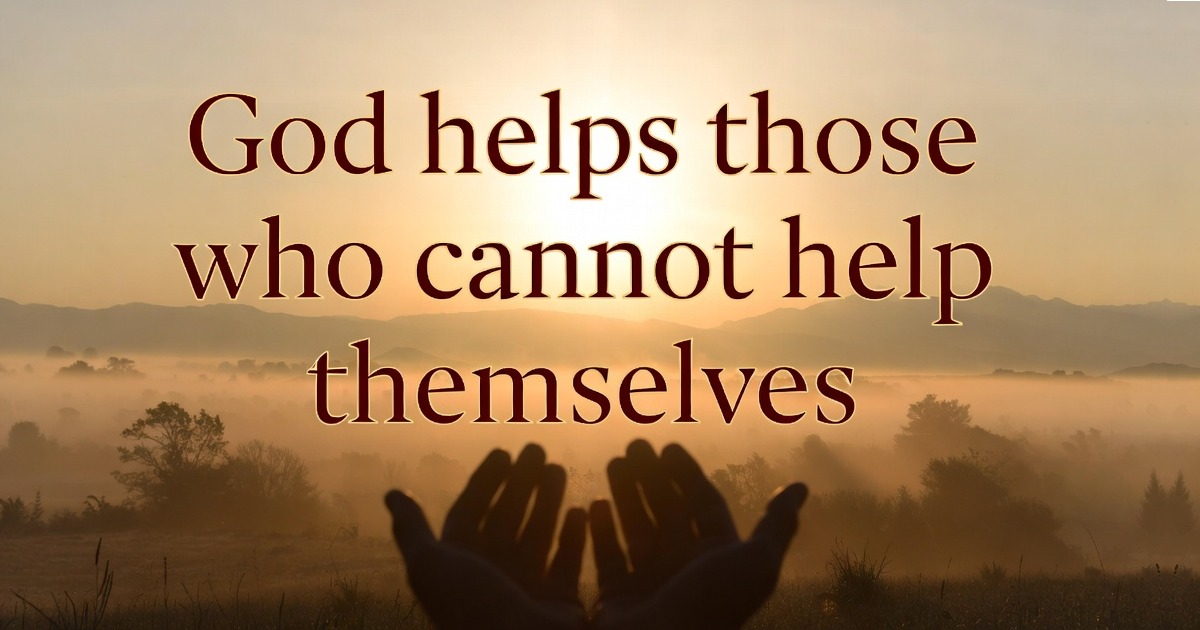
The gospel is not “God helps those who help themselves.”
The gospel is God helps those who cannot help themselves — because we are spiritually bankrupt without Him. The Bible teaches that God helps the helpless.
Jesus never waited for people to get their lives together. He pursued the broken, the sinner, the outcast, and the desperate. He is not a distant observer — He is a rescuer who initiates, carries, and completes what we never could.
Why This Myth Matters
The myth promotes a works-based or self-reliant mindset that undermines the core of the gospel: God’s unmerited grace toward sinners who cannot save or fix themselves.
When people embrace “God helps those who help themselves,” they unconsciously adopt a worldview where:
The truly broken and helpless lose hope.
Salvation feels like a cooperative effort where we must earn God’s favor.
Pride is encouraged instead of crucified.
People remain trapped in performance-based religion instead of resting in Christ’s finished work.
This is the exact opposite of the Christian message. The Bible presents a God who is intimately involved in our lives, especially in our weakness. His strength is made perfect in our helplessness (2 Corinthians 12:9).
The biblical truth offers far better news: You don’t have to clean yourself up before God will help you. Come as you are — helpless, sinful, exhausted — and He will meet you with mercy.
Conclusion
The popular saying “God helps those who help themselves” sounds motivational, but it quietly pushes God to the margins and places the full weight of life on our shoulders.
The biblical truth is far better news: You are not alone. You do not have to carry the burden by yourself. While you were still helpless — exhausted, failing, or far from God — Christ came for you. God is not waiting for you to get strong enough to deserve His help. He helps the helpless, because that’s who we all are without Him.
Come as you are. Rest in His grace. Let Him do what only He can do.The next time someone quotes this myth, you can gently reply: “That’s closer to Benjamin Franklin than the Bible. Here’s what God actually says about helping those who cannot help themselves.”
Reliable Voices on This Topic
Grace to You (gty.org) — John MacArthur’s teachings and Q&As on common misconceptions.
Folsom Bible Church (folsombiblechurch.org) — Gospel-centered resources emphasizing dependence on Christ.
Works and sermons by Martin Luther on justification by faith.
Lee Strobel’s investigative approach to biblical truth claims.