Does the Bible Say Life Begins at First Breath?
OK, here it goes. Let’s call abortion for what it is: murder. Perhaps if we stick to the proper names for things, and stop inventing new terms to make what we do sound less evil, we would actually think before committing evil acts.
How did we go from murder — which most people would still agree is one of the greatest offenses against humanity — to calling it healthcare? Healthcare for whom? Certainly not for the innocent, unborn life. So healthcare for the mother? How can it be healthcare when it destroys? Isn’t healthcare supposed to treat illness and make us better? Or is it healthcare for the father? Uh-oh — now we are getting into dangerous territory. We are only supposed to consider the mother in the case of abortion, and only her needs matter. That sounds pretty selfish.
I decided to write this blog post because I recently heard one of my friends claim that the Bible says life begins with the first breath, and that an embryo does not breathe air on its own; therefore, abortion is compatible with Scripture.
I really did not know how to respond. I knew this was not so, but I was not sure how to answer. It did not help that I was the one behind the wheel and had to concentrate on the road. Still, it should not have been difficult. So here is my response after I had a bit of time to think about it.
I think the best premise is this: human life belongs to God, and it is to be protected.
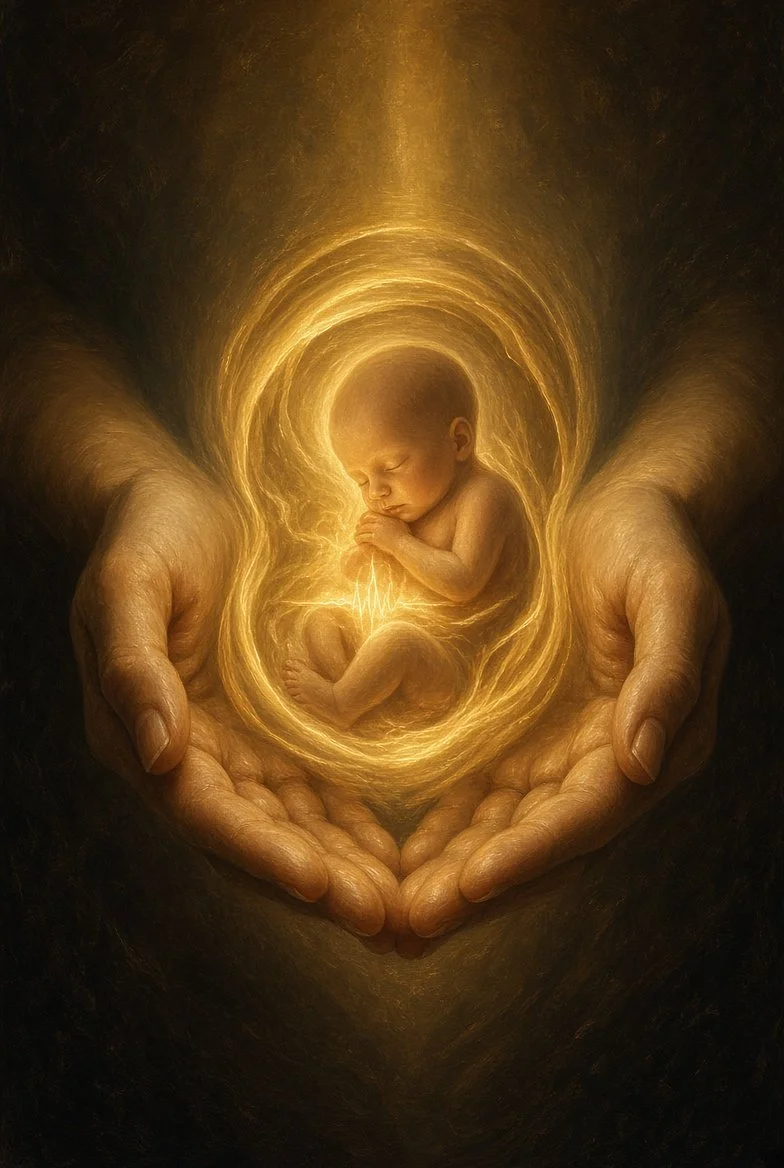
Jeremiah 1:5
“Before I formed you in the womb I knew you”
The first-breath claim
The argument is not hard to follow. Genesis 2:7 says Adam became a living creature when God breathed into him. The unborn child does not breathe room air on its own. Therefore, the claim goes, the child is not yet the kind of “living soul” the command against murder covers.
Exodus 21:22 is then added: if a fight causes a child to “come out” and the penalty can be a fine, the unborn look cheaper than a born person. On that reading, abortion is not blessed in so many words, but it is not forbidden either. That is the strongest form of the case — but only when taken out of context. Otherwise it absolutely fails.
It takes a unique creation scene of the first human and applies it to being created in the womb, and it treats a law about the accidental causing of premature birth as permission to murder. It quickly falls apart when you read the next few verses. They say that if harm follows, the penalty is “life for life.”
“If men fight and hurt a pregnant woman so that she gives birth prematurely, and yet no harm follows, he shall be surely fined as much as the woman’s husband demands and the judges allow. But if any harm follows, then you must take life for life, eye for eye, tooth for tooth, hand for hand, foot for foot, burning for burning, wound for wound, and bruise for bruise.”
That debate about miscarriage versus premature birth matters for how ancient Israel assigned damages. It does not create a right to abort. The case is accidental injury during a brawl. Abortion is the intentional ending of a pregnancy. A penalty for harm caused by a fight is not permission to murder. Exodus 20:13 still stands next to Exodus 21.
What Genesis 2:7 actually says
“Yahweh God formed man from the dust of the ground, and breathed into his nostrils the breath of life; and man became a living soul.”
Adam is not an embryo. He is not in a womb. He is formed as an adult from dust that had no life at all. God is not describing ordinary human development. He is describing the one-time origin of the first man. Eve is formed in another unique way, from Adam’s side. Neither story is a medical timeline for every child conceived after them.
The “does not breathe” part is imprecise. The unborn already exchange oxygen through the mother. Birth changes the route of respiration, not the fact that a living human organism is present and developing. If “first breath” were the moral line, a newborn who does not breathe for the first moments would fall outside protection. Almost no one believes that.
What the Bible teaches about protecting human life
The Bible’s moral center on this question is that human beings bear God’s image and that innocent blood is not ours to shed.
Genesis 1:26–27 says God made mankind in his image, male and female. That is the ground of human worth. His first word to that pair was “Be fruitful and multiply and fill the earth” (Genesis 1:28). Genesis 9:6 then ties bloodshed to the same image: “Whoever sheds the blood of man, by man shall his blood be shed, for God made man in his own image.” Exodus 20:13 states the command without a gestational clause: “You shall not murder.”
The same Scriptures speak of God at work before birth. “Before I formed you in the womb I knew you, and before you were born I consecrated you” (Jeremiah 1:5). Psalm 139:13–16 says God knitted the person together in the womb, saw the unformed substance, and wrote the days before one of them existed.
Job 31:15 makes the same point from the other direction. Job will not mistreat his servant because “he who made me in the womb” also made him. Two people. Two wombs. One Maker. If God fashions a neighbor in the womb, that is not where a child waits to become human.
Luke 1 is harder still to wave away. John leaps in the womb. Luke uses brephos — the same word he uses for a newborn — for the child still inside Elizabeth. She then calls Mary “the mother of my Lord” while Jesus is still unborn (Luke 1:41–44). The text does not wait for first breath to speak of a baby, a mother, and the Lord.
Psalm 127:3 fits the same posture: “Behold, children are a heritage from the Lord, the fruit of the womb a reward.”
Scripture also condemns offering children to Molech (Leviticus 18:21; Deuteronomy 12:31). When Israel copied the nations, the prophets said innocent blood filled the land (Psalm 106:37–38; Jeremiah 7:31). Modern abortion is not a temple rite. The comparison is the choice: a society ends a child because the child is young, dependent, or in the way. God judges that willful killing of the young, including when a culture gives it a softer name.
Hard cases
People raise rape, a fatal diagnosis, and danger to the mother’s life because those situations are real.
A child conceived in rape is still a child. The crime belongs to the offender. The mother’s pain is real and she should be cared for. That pain does not make the child guilty, and it does not cancel “You shall not murder.”
A fatal diagnosis is grief before the fact. The child may live only a short time, or suffer, or not survive long after birth. That does not make the child less human. Doctors are sometimes wrong. Even when they are not, a short life is still a life.
If continuing the pregnancy is killing the mother, or is about to, two lives made in God’s image are already there. Then the question is how to save whom you can. That is not a general rule for abortion. It is not the first-breath argument either.
Does the Bible support abortion?
No. Genesis 2:7 is about Adam, formed from dust. It is not a rule that the unborn may be discarded. The Bible never uses the word “abortion.” It does say that man is made in God’s image, that we shall not murder, that God forms a child in the womb, and that the child in the womb is spoken of as a child.
God formed that child in the dark. The first breath does not create the child. It only announces the one already there.