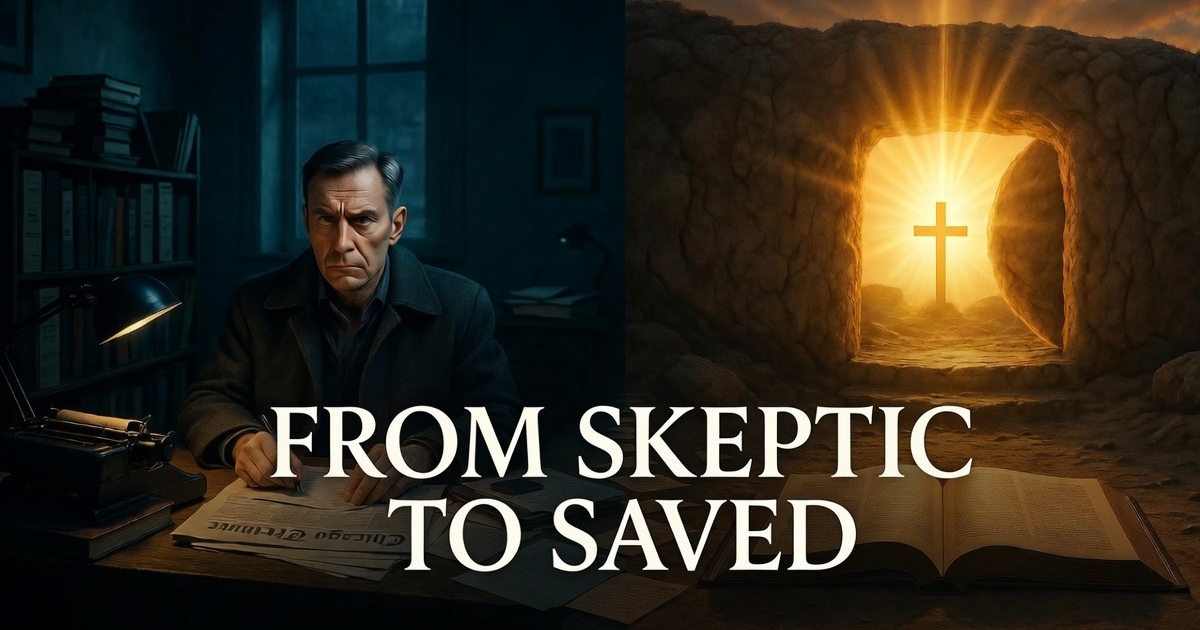
From Skeptic to Saved
How Lee Strobel’s Investigation Led Him to Jesus
What if the evidence you gathered to disprove Christianity ended up proving it true? That’s precisely what happened to Lee Strobel — the award-winning atheist journalist whose two-year quest to dismantle the Christian faith became the foundation for one of the most compelling cases for Christ ever written.
If you’re skeptical about the Bible, unsure about salvation, or wondering whether faith is just wishful thinking, Lee’s story is for you. It’s a powerful reminder that Christianity isn’t built on blind belief but on historical facts that can withstand the toughest scrutiny. Let’s dive deep into his transformation and see how it points every one of us toward the hope found only in Christ.
The Atheist on a Mission
In the late 1970s, Lee Strobel was a Yale-educated legal editor at the Chicago Tribune. Proudly atheist, he saw Christianity as a crutch for the weak-minded — a collection of myths and legends with no basis in reality.
Then came the unwelcome surprise. His wife, Leslie, announced she had become a Christian. For Lee, this was a crisis. He feared she had joined a cult that would destroy their marriage and family. Angry, scared, and determined to “rescue” her, he did what any good investigative journalist would do: he launched a full-scale, two-year investigation to disprove Christianity once and for all.
Using his journalistic and legal training, he spent nearly two years interviewing top scholars, historians, archaeologists, and medical experts. Lee systematically examined the central claims of the faith - especially the resurrection of Jesus, which he knew was the make-or-break issue. As the Apostle Paul wrote:
“If Christ has not been raised, your faith is vain; you are still in your sins.”
His goal: disprove the resurrection of Jesus — the cornerstone of the Christian faith. Lee set out to show that the resurrection was a hoax, a legend, or a delusion.
What he discovered instead changed everything.
The 5 Es: The Evidence That Convinced a Skeptic
Lee didn’t rely on feelings or blind faith. He followed the facts. Over nearly 600 days of research, Lee probed the reliability of the New Testament documents, the historical facts surrounding Jesus’ life, death, and reported resurrection, and alternative explanations for the empty tomb.
In his presentations and writings, he often summarizes the overwhelming historical evidence for the resurrection using the memorable “5 Es” (sometimes presented as four core points with a powerful fifth). These became the intellectual turning point in his journey:
Execution — Jesus Really Died
Roman crucifixion was a brutally efficient method of execution. Medical experts, including a 1986 study in the Journal of the American Medical Association, confirm Jesus was dead long before the spear pierced His side. Non-Christian historians like Tacitus and Josephus independently verify His execution under Pontius Pilate. There was no “swoon theory” or survival — Jesus was unequivocally dead.Early Accounts — The Reports Came Too Soon for Legend
Skeptics sometimes claim the resurrection stories developed decades later as legend. But we have a powerful early creed preserved in 1 Corinthians 15:3-7, dated by scholars to within months or just a few years of the crucifixion (around A.D. 33–38). That’s far too early for myth to overtake facts. Eyewitnesses were still alive to correct any errors.Empty Tomb — Even Jesus’ Enemies Admitted It
The tomb was empty — a fact never seriously disputed in the first century. The Jewish leaders claimed the disciples stole the body, which ironically confirms the tomb was empty. Women (whose testimony was not highly valued in that culture) were the first witnesses — an embarrassing detail that lends credibility. No one could produce a body to stop the movement.Eyewitness Experiences — Hundreds Saw the Risen Jesus
The risen Christ appeared to individuals, small groups, and more than 500 people at once. These weren’t hallucinations (group hallucinations don’t work that way). The witnesses included skeptics (such as Thomas and James, the brother of Jesus) and even a former enemy of the church (Paul, who had violently persecuted Christians before the risen Christ appeared to him). These encounters turned fearful disciples into bold proclaimers who were willing to die for what they saw.Explosion (or Enemies’ Failure) — The Rapid Rise of the Church
How do you explain the explosive growth of Christianity in Jerusalem — right where it could be most easily disproven — in the face of intense persecution? The disciples went from hiding to boldly preaching in the streets. Even Jesus’ enemies couldn’t produce evidence against the claims. Something extraordinary had happened.
Lee didn’t approach this with an open mind at first — he was hostile to the claims. But the cumulative weight of the evidence was undeniable. As he later reflected: “In light of the avalanche of evidence that points so powerfully toward the truth of Christianity, it would take more faith to maintain my atheism than to become a Christian.”
This is crucial for anyone wrestling with doubt today. The Bible isn’t asking you to check your brain at the door. It invites rigorous examination. Lee’s journey proves that honest investigation leads toward Jesus, not away from Him.
The Moment of Surrender: November 8, 1981
After two years of digging, the intellectual case was closed. But salvation requires more than head knowledge — it demands the heart. Lee sat in his living room, confronted by the truth. He realized believing the facts wasn’t enough; he had to receive the gift of grace offered through Jesus’ death on the cross.
He turned to John 1:12:
“But as many as received him, to them he gave the right to become God’s children, to those who believe in his name”
On his knees, Lee confessed a lifetime of sin and immorality, repented, and received forgiveness. He didn’t experience an immediate emotional high — but he had the unshakable confidence of reason: “This is true. This isn’t make-believe.
That day, Lee Strobel was saved. His life, marriage, and career were transformed. He left journalism, became a pastor, and wrote The Case for Christ — a book that has helped millions examine the evidence for themselves.
Why Lee Strobel’s Story Matters for You Today
Lee’s journey proves several powerful truths:
The Bible Holds Up Under Scrutiny: Honest investigation strengthens faith rather than destroying it. If a skeptical journalist couldn’t dismantle it, perhaps it’s time you examined the claims for yourself. Start with the Gospels. Read them as historical documents. The evidence is there.
Salvation Is a Free Gift (by grace through faith), Not Earned: Lee didn’t clean up his life first. He came as he was - flawed, sinful, and in need of grace. Ephesians 2:8-9 reminds us: “for by grace you have been saved through faith, and that not from yourselves; it is the gift of God, not of works, that no one would boast.” Jesus paid the price on the cross so you don’t have to.
No One Is Beyond Hope: Lee was the “hard-headed, hard-hearted” editor. His wife’s friends prayed anyway. God answered. Whatever your background — atheist, skeptic, or nominal believer — Jesus stands ready to receive you. He is not threatened by doubt. Bring your hardest questions to Him.
If you’re reading this and feeling the weight of evidence — or even just a nudge in your spirit — don’t wait. Pray and ask God to reveal the truth to you. Like Lee, you can pray a simple prayer of repentance and faith: Admit your need, believe in what Jesus did, and receive Him as Lord and Savior.
The same avalanche of evidence that convinced Lee Strobel is available to you today. The question isn’t whether the case for Christ is strong enough. It’s whether you’re willing to follow the evidence where it leads. The same Savior who met Lee Strobel on the other side of his investigation is waiting for you.
Jesus is waiting. Will you receive Him?
Lee Strobel: The case for Christ. In this video, Lee Strobel goes through the main points he found that shifted his mind and heart about the truth surrounding the resurrection of Jesus.
The Case for Christ
Lee Strobel methodically applies his legal and journalistic skills to examine the historical evidence for Jesus’ life, death, and resurrection, ultimately concluding that the case for Christianity is overwhelming and rationally compelling.