God's Covenants: The Backbone of Redemption
The Bible is one unified story: God creating humanity for relationship, humanity breaking that relationship through sin, and God relentlessly pursuing us with unbreakable promises. At the heart of this story are covenants — solemn, binding agreements far more serious than modern contracts. These covenants reveal who God is and how He redeems a broken world.
Have you ever wondered why God keeps making promises even when people fail? The answer lies in these covenants. They show God who initiates, preserves, disciplines, and ultimately saves — all pointing to Jesus Christ.
Definitions of Covenant Types
Before diving in, here are the key terms (drawn from John MacArthur teaching):
Unilateral: God alone makes the binding commitment (“I will…”). He takes full responsibility — like a king granting a royal gift.
Bilateral: Both God and people have obligations (“If you obey… then I will bless”).
Unconditional: God’s core promises cannot be canceled by human failure. They are irrevocable and everlasting.
Conditional: Blessings depend on obedience. Disobedience brings consequences, but God’s ultimate plan continues.
Most of God’s covenants with humanity are both unilateral and unconditional. The Mosaic Covenant is the main exception.
Major Covenants in the Bible
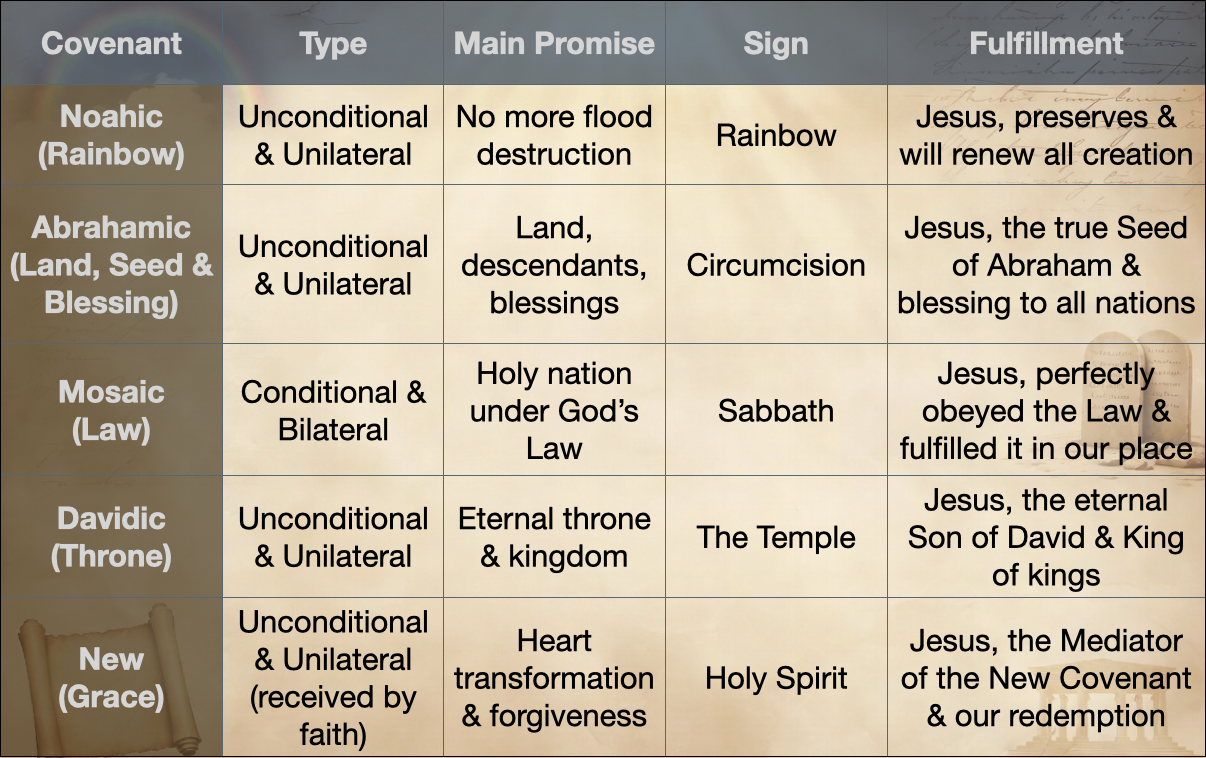
Now, let’s walk through each covenant in detail.
1. The Noahic Covenant (Preservation After the Flood)
Type: Unconditional and unilateral.
Key Verse (WEB)
-
18 But I will establish my covenant with you. You shall come into the ship, you, your sons, your wife, and your sons’ wives with you.
-
20 Noah built an altar to Yahweh, and took of every clean animal, and of every clean bird, and offered burnt offerings on the altar. 21 Yahweh smelled the pleasant aroma. Yahweh said in his heart, “I will not again curse the ground any more for man’s sake because the imagination of man’s heart is evil from his youth. I will never again strike every living thing, as I have done. 22 While the earth remains, seed time and harvest, and cold and heat, and summer and winter, and day and night will not cease.”
-
1 God blessed Noah and his sons, and said to them, “Be fruitful, multiply, and replenish the earth. 2 The fear of you and the dread of you will be on every animal of the earth, and on every bird of the sky. Everything that moves along the ground, and all the fish of the sea, are delivered into your hand. 3 Every moving thing that lives will be food for you. As I gave you the green herb, I have given everything to you. 4 But flesh with its life, that is, its blood, you shall not eat. 5 I will surely require accounting for your life’s blood. At the hand of every animal I will require it. At the hand of man, even at the hand of every man’s brother, I will require the life of man. 6 Whoever sheds man’s blood, his blood will be shed by man, for God made man in his own image. 7 Be fruitful and multiply. Increase abundantly in the earth, and multiply in it.”
8 God spoke to Noah and to his sons with him, saying, 9 “As for me, behold, establish my covenant with you, and with your offspring after you, 10 and with every living creature that is with you: the birds, the livestock, and every animal of the earth with you, of all that go out of the ship, even every animal of the earth. 11 I will establish my covenant with you: All flesh will not be cut off anymore by the waters of the flood. There will never again be a flood to destroy the earth.” 12 God said, “This is the token of the covenant which I make between me and you and every living creature that is with you, for perpetual generations: 13 I set my rainbow in the cloud, and it will be a sign of a covenant between me and the earth. 14 When I bring a cloud over the earth, that the rainbow will be seen in the cloud, 15 I will remember my covenant, which is between me and you and every living creature of all flesh, and the waters will no more become a flood to destroy all flesh. 16 The rainbow will be in the cloud. I will look at it, that I may remember the everlasting covenant between God and every living creature of all flesh that is on the earth.” 17 God said to Noah, “This is the token of the covenant which I have established between me and all flesh that is on the earth.”

Explanation
After widespread evil and the Flood, God made an unconditional promise: He would never again destroy the earth with a flood. The rainbow serves as the visible, permanent sign of this covenant. Because it is universal (made with all humanity and every living creature), it ensures that history can continue and God’s plan of redemption can unfold. This covenant rests entirely on God’s unchanging word.
2. The Abrahamic Covenant (Land, Seed, and Global Blessing)
Type: Unconditional and unilateral.
Key Verses (WEB)
-
1 Now Yahweh said to Abram, “Leave your country, and your relatives, and your father’s house, and go to the land that I will show you. 2 I will make of you a great nation. I will bless you and make your name great. You will be a blessing. 3 I will bless those who bless you, and I will curse him who treats you with contempt. All the families of the earth will be blessed through you.”
-
14 Yahweh said to Abram, after Lot was separated from him, “Now, lift up your eyes, and look from the place where you are, northward and southward and eastward and westward, 15 for I will give all the land which you see to you and to your offspring forever. 16 I will make your offspring as the dust of the earth, so that if a man can count the dust of the earth, then your offspring may also be counted. 17 Arise, walk through the land in its length and in its width; for I will give it to you.”
-
After these things Yahweh’s word came to Abram in a vision, saying, “Don’t be afraid, Abram. I am your shield, your exceedingly great reward.”
2 Abram said, “Lord Yahweh, what will you give me, since I go childless, and he who will inherit my estate is Eliezer of Damascus?” 3 Abram said, “Behold, you have given no children to me: and, behold, one born in my house is my heir.”
4 Behold, Yahweh’s word came to him, saying, “This man will not be your heir, but he who will come out of your own body will be your heir.” 5 Yahweh brought him outside, and said, “Look now toward the sky, and count the stars, if you are able to count them.” He said to Abram, “So your offspring will be.” 6 He believed in Yahweh, who credited it to him for righteousness. 7 He said to Abram, “I am Yahweh who brought you out of Ur of the Chaldees, to give you this land to inherit it.”
8 He said, “Lord Yahweh, how will I know that I will inherit it?”
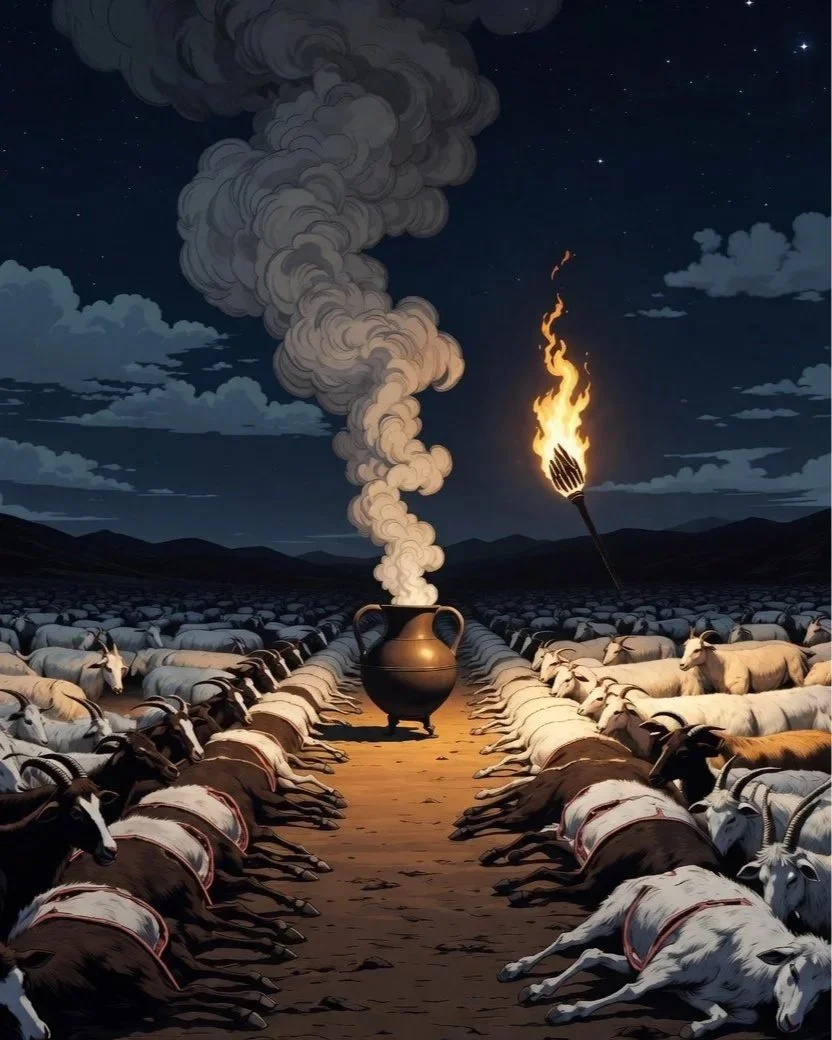
9 He said to him, “Bring me a heifer three years old, a female goat three years old, a ram three years old, a turtledove, and a young pigeon.” 10 He brought him all these, and divided them in the middle, and laid each half opposite the other; but he didn’t divide the birds. 11 The birds of prey came down on the carcasses, and Abram drove them away.
12 When the sun was going down, a deep sleep fell on Abram. Now terror and great darkness fell on him. 13 He said to Abram, “Know for sure that your offspring will live as foreigners in a land that is not theirs, and will serve them. They will afflict them four hundred years. 14 I will also judge that nation, whom they will serve. Afterward they will come out with great wealth; 15 but you will go to your fathers in peace. You will be buried at a good old age. 16 In the fourth generation they will come here again, for the iniquity of the Amorite is not yet full.” 17 It came to pass that, when the sun went down, and it was dark, behold, a smoking furnace and a flaming torch passed between these pieces. 18 In that day Yahweh made a covenant with Abram, saying, “I have given this land to your offspring, from the river of Egypt to the great river, the river Euphrates: 19 the land of the Kenites, the Kenizzites, the Kadmonites, 20 the Hittites, the Perizzites, the Rephaim, 21 the Amorites, the Canaanites, the Girgashites, and the Jebusites.”
-
2 I will make my covenant between me and you, and will multiply you exceedingly.”
3 Abram fell on his face. God talked with him, saying, 4 “As for me, behold, my covenant is with you. You will be the father of a multitude of nations. 5 Your name will no more be called Abram, but your name will be Abraham; for I have made you the father of a multitude of nations. 6 I will make you exceedingly fruitful, and I will make nations of you. Kings will come out of you. 7 I will establish my covenant between me and you and your offspring after you throughout their generations for an everlasting covenant, to be a God to you and to your offspring after you. 8 I will give to you, and to your offspring after you, the land where you are traveling, all the land of Canaan, for an everlasting possession. I will be their God.”
9 God said to Abraham, “As for you, you shall keep my covenant, you and your offspring after you throughout their generations. 10 This is my covenant, which you shall keep, between me and you and your offspring after you. Every male among you shall be circumcised. 11 You shall be circumcised in the flesh of your foreskin. It will be a token of the covenant between me and you. 12 He who is eight days old shall be circumcised among you, every male throughout your generations, he who is born in the house, or bought with money from any foreigner who is not of your offspring. 13 He who is born in your house, and he who is bought with your money, must be circumcised. My covenant shall be in your flesh for an everlasting covenant. 14 The uncircumcised male who is not circumcised in the flesh of his foreskin, that soul shall be cut off from his people. He has broken my covenant.”
-
14 Abraham called the name of that place “Yahweh Will Provide”. As it is said to this day, “On Yahweh’s mountain, it will be provided.”
15 Yahweh’s angel called to Abraham a second time out of the sky, 16 and said, ‘I have sworn by myself,’ says Yahweh, ‘because you have done this thing, and have not withheld your son, your only son, 17 that I will bless you greatly, and I will multiply your offspring greatly like the stars of the heavens, and like the sand which is on the seashore. Your offspring will possess the gate of his enemies. 18 All the nations of the earth will be blessed by your offspring, because you have obeyed my voice.’
19 So Abraham returned to his young men, and they rose up and went together to Beersheba. Abraham lived at Beersheba.
Explanation
God called Abram (later Abraham) and made three core promises: numerous descendants, the land of Canaan, and blessing to all nations. God alone walked through the animal pieces — symbolizing that He would bear any curse if the promises failed. Circumcision was later given as the sign.
3. The Mosaic (Sinai/Old) Covenant (Law and National Life)
Type: Conditional and bilateral.
Key Verses (WEB)
-
5 Now therefore, if you will indeed obey my voice and keep my covenant, then you shall be my own possession from among all peoples; for all the earth is mine; 6 and you shall be to me a kingdom of priests and a holy nation.’ These are the words which you shall speak to the children of Israel.”
-
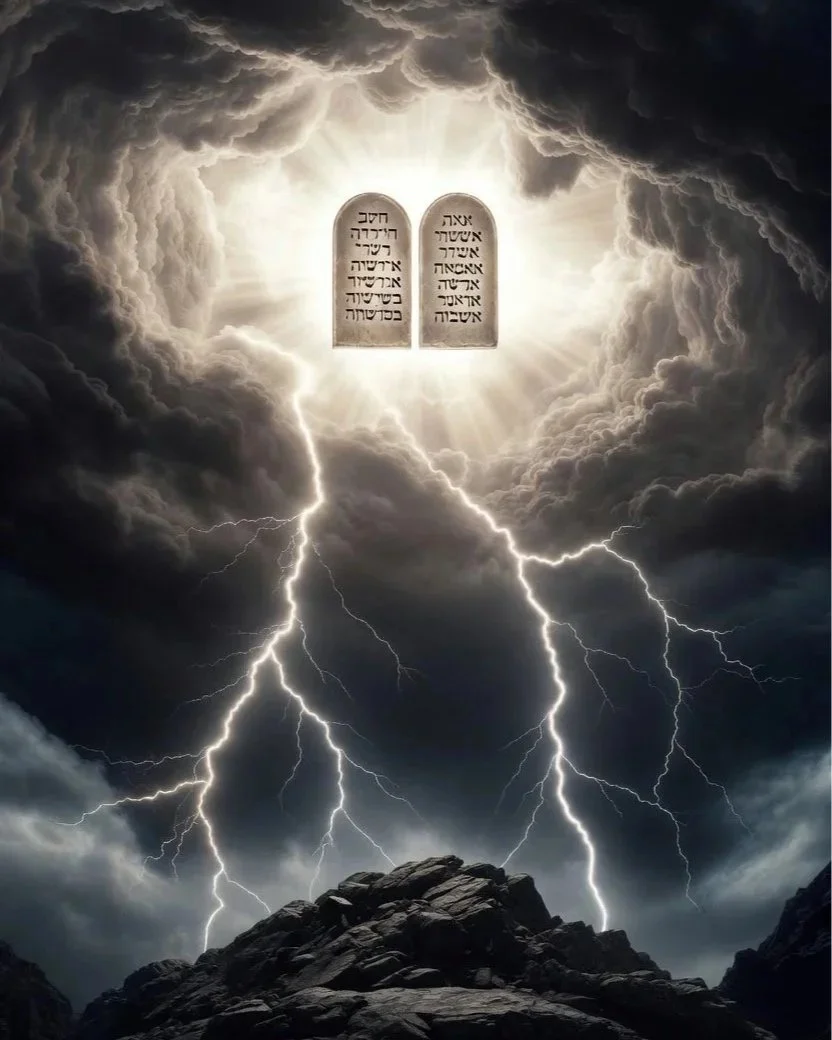
1 God spoke all these words, saying, 2 “I am Yahweh your God, who brought you out of the land of Egypt, out of the house of bondage.
3 “You shall have no other gods before me.
4 “You shall not make for yourselves an idol, nor any image of anything that is in the heavens above, or that is in the earth beneath, or that is in the water under the earth: 5 you shall not bow yourself down to them nor serve them, for I, Yahweh your God, am a jealous God, visiting the iniquity of the fathers the children, on the third generation of those who hate me, 6 and showing loving kindness to thousands of those who love me and keep my commandments.
7 “You shall not misuse the name of Yahweh your God, for Yahweh will not hold him guiltless who misuses his name.
8 “Remember the Sabbath day, to keep it holy. 9 You shall labor six days, and do all your work, 10 but the seventh day is Sabbath to Yahweh your God. You shall not do any work in it, you, nor your son, nor your daughter, you male servant, nor your female servant, nor your livestock, nor your stranger who is within your gates; 11 for in six days Yahweh made heaven and earth, the sea, and all that is in them, and rested the seventh day; therefore Yahweh blessed the Sabbath day, and made it holy.
12 “Honor your father and your mother, that your days may be long in the land which Yahweh your God gives you.
13 “You shall not murder.
14 “You shall not commit adultery.
15 “You shall not steal.
16 “You shall not give false testimony against your neighbor.
17 “You shall not covet your neighbor’s house. You shall not covet your neighbor’s wife, nor his male servant, nor his female servant, nor his ox, nor his donkey, nor anything that is your neighbor’s.”
-
3 Moses came and told the people all Yahweh’s words, and all the ordinances; and all the people answered with one voice, and said, “All the words which Yahweh has spoken will we do.”
4 Moses wrote all Yahweh’s words, then rose up early in the morning and built an altar at the base of the mountain, with twelve pillars for the twelve tribes of Israel. 5 He sent young men of the children of Israel, who offered burnt offerings and sacrificed peace offerings of cattle to Yahweh. 6 Moses took half of the blood and put it in basins, and half of the blood he sprinkled on the altar. 7 He took the book of the covenant and read it in the hearing of the people, and they said, “We will do all that Yahweh has said, and be obedient.”
8 Moses took the blood, and sprinkled it on the people, and said, “Look, this is the blood of the covenant, which Yahweh has made with you concerning all these words.”
-
This chapter is very long (68 verses). Here is a clear summary with key excerpts:
Blessings for Obedience (Deuteronomy 28:1-14)
“It shall happen, if you shall listen diligently to Yahweh your God’s voice, to observe to do all his commandments which I command you today, that Yahweh your God will set you high above all the nations of the earth. 2 All these blessings will come upon you, and overtake you, if you listen to Yahweh your God’s voice. 3 You shall be blessed in the city, and you shall be blessed in the field… 8 Yahweh will command the blessing on you in your barns, and in all that you put your hand to. He will bless you in the land which Yahweh your God gives you.”Curses for Disobedience (Deuteronomy 28:15-68)
“15 But it shall come to pass, if you will not listen to Yahweh your God’s voice, to observe to do all his commandments and his statutes which I command you today, that all these curses will come on you and overtake you. 16 You will be cursed in the city, and you will be cursed in the field. 17 Your basket and your kneading trough will be cursed… 20 Yahweh will send on you cursing, confusion, and rebuke in all that you put your hand to do, until you are destroyed and until you perish quickly, because of the evil of your doings, by which you have forsaken me.”
John MacArthur teaches that this covenant was never a way of salvation but a tutor that exposes sin and points to our need for Christ (Galatians 3:24). Martin Luther emphasized its role in ordering earthly life while distinguishing it from the gospel of grace.
Explanation
After rescuing Israel from slavery in Egypt, God met them at Mount Sinai and established the Mosaic Covenant. Its purpose was to shape them into a holy nation set apart for God, providing detailed laws for worship, morality, justice, and daily life. The Sabbath was given as its special sign. Unlike the unconditional covenants, this one was conditional: if Israel obeyed God’s commands, they would experience His blessing and dwell securely in the Promised Land. If they disobeyed, they would face discipline and eventual exile.
5. The Davidic Covenant (Eternal Kingdom)
Type: Unconditional and unilateral.
Key Verses (WEB)
-
8 Now therefore tell my servant David this: ‘Yahweh of Armies says, “I took you from the sheep pen, from following the sheep, to be prince over my people, over Israel. 9 I have been with you wherever you went, and have cut off all your enemies from before you. I will make you a great name, like the name of the great ones who are in the earth. 10 I will appoint a place for my people Israel, and will plant them, that they may dwell in their own place and be moved no more. The children of wicked ness will not afflict them any more, as at the first, 11 and as from the day that I commanded judges to be over my people Israel. I will cause you to rest from all your enemies. Moreover Yahweh tells you that Yahweh will make you a house. 12 When your days are fulfilled and you sleep with your fathers, I will set up your offspring after you, who will proceed out of your body, and I will establish his kingdom. 13 He will build a house for my name, and I will establish the throne of his kingdom forever. 14 I will be his father, and he will be my son. If he commits iniquity, I will chasten him with the rod of men and with the stripes of the children of men; 15 but my loving kindness will not depart from him, as I took it from Saul, whom I put away before you. 16 Your house and your kingdom will be made sure forever before you. Your throne will be established forever.” ’ ” 17 Nathan spoke to David all these words, and according to all this vision.
-
5 Isn’t my house so with God?
Yet he has made with me an everlasting covenant,
ordered in all things, and sure,
for it is all my salvation and all my desire.
Won’t he make it grow?
-
When David was living in his house, David said to Nathan the prophet, “Behold, I live in a cedar house, but the ark of Yahweh’s covenant is in a tent.”
2 Nathan said to David, “Do all that is in your heart; for God is with you.”
3 That same night, the word of God came to Nathan, saying, 4 “Go and tell David my servant, ‘Yahweh says, “You shall not build me a house to dwell in; 5 for I have not lived in a house since the day that I brought up Israel to this day, but have gone from tent to tent, and from one tent to another. 6 In all places in which I have walked with all Israel, did I speak a word with any of the judges of Israel, whom I commanded to be shepherd of my people, saying, ‘Why have you not built me a house of cedar?’ ” ’
7 “Now therefore, you shall tell my servant David, ‘Yahweh of Armies says, “I took you from the sheep pen, from following the sheep, to be prince over my people Israel. 8 I have been with you wherever you have gone, and have cut off all your enemies from before you. I will make you a name like the name of the great ones who are in the earth. 9 I will appoint a place for my people Israel, and will plant them, that they may dwell in their own place, and be moved no more. The children of wickedness will not waste them any more, as at the first, 10 and from the day that I commanded judges to be over my people Israel. I will subdue all your enemies. Moreover I tell you that Yahweh will build you a house. 11 It will happen, when your days are fulfilled that you must go to be with your fathers, that I will set up your offspring after you, who will be of your sons; and I will establish his kingdom. 12 He will build me a house, and I will establish his throne forever. 13 I will be his father, and he will be my son. I will not take my loving kindness away from him, as I took it from him who was before you; 14 but I will settle him in my house and in my kingdom forever. His throne will be established forever.” ’ ” 15 According to all these words, and according to all this vision, so Nathan spoke to David.
16 Then David the king went in and sat before Yahweh; and he said, “Who am I, Yahweh God, and what is my house, that you have brought me this far? 17 This was a small thing in your eyes, O God, but you have spoken of your servant’s house for a great while to come, and have respected me according to the standard of a man of high degree, Yahweh God. 18 What can David say yet more to you concerning the honor which is done to your servant? For you know your servant. 19 Yahweh, for your servant’s sake, and according to your own heart, you have done all this greatness, to make known all these great things. 20 Yahweh, there is no one like you, neither is there any God besides you, according to all that we have heard with our ears. 21 What one nation in the earth is like your people Israel, whom God went to redeem to himself for a people, to make you a name by great and awesome things, in driving out nations from before your people whom you redeemed out of Egypt? 22 For you made your people Israel your own people forever; and you, Yahweh, became their God. 23 Now, Yahweh, let the word that you have spoken concerning your servant, and concerning his house, be established forever, and do as you have spoken. 24 Let your name be established and magnified forever, saying, ‘Yahweh of Armies is the God of Israel, even a God to Israel. The house of David your servant is established before you.’ 25 For you, my God, have revealed to your servant that you will build him a house. Therefore your servant has found courage to pray before you. 26 Now, Yahweh, you are God, and have promised this good thing to your servant. 27 Now it has pleased you to bless the house of your servant, that it may continue forever before you; for you, Yahweh, have blessed, and it is blessed forever.”
-
19 Then you spoke in vision to your saints,
and said, “I have given strength to the warrior.
I have exalted a young man from the people.
20 I have found David, my servant.
I have anointed him with my holy oil,
21 with whom my hand shall be established.
My arm will also strengthen him.
22 No enemy will tax him.
No wicked man will oppress him.
23 I will beat down his adversaries before him,
and strike those who hate him.
24 But my faithfulness and my loving kindness will be with him.
In my name, his horn will be exalted.
25 I will set his hand also on the sea,
and his right hand on the rivers.
26 He will call to me, ‘You are my Father,
my God, and the rock of my salvation!’
27 I will also appoint him my firstborn,
the highest of the kings of the earth.
28 I will keep my loving kindness for him forever more.
My covenant will stand firm with him.
29 I will also make his offspring endure forever,
and his throne as the days of heaven.
30 If his children forsake my law,
and don’t walk in my ordinances;
31 if they break my statutes,
and don’t keep my commandments;
32 then I will punish their sin with the rod,
and their iniquity with stripes.
33 But I will not completely take my loving kindness from him,
nor allow my faithfulness to fail.
34 I will not break my covenant,
nor alter what my lips have uttered.
35 Once I have sworn by my holiness,
I will not lie to David.
36 His offspring will endure forever,
his throne like the sun before me.
37 It will be established forever like the moon,
the faithful witness in the sky.”
Explanation: God promised David that one of his descendants would rule on an everlasting throne. Individual failures in the royal line would bring correction, but the promise itself could never be revoked. This builds directly on the Abrahamic “seed” promise and is fulfilled in Jesus, the Son of David and King of kings (Luke 1:32-33).
5. The New Covenant (Fulfillment in Jesus)
Type: Unconditional and unilateral in God’s promises, received by faith.
Key Verses (WEB)
-
31 “Behold, the days come,” says Yahweh, “that I will make a new covenant with the house of Israel, and with the house of Judah, 32 not according to the covenant that I made with their fathers in the day that I took them by the hand to bring them out of the land of Egypt, which covenant of mine they broke, although I was a husband to them,” says Yahweh. 33 “But this is the covenantthat I will make with the house of Israel after those days,” says Yahweh:
“I will put my law in their inward parts,
and I will write it in their heart.
I will be their God,
and they shall be my people.
34 They will no longer each teach his neighbor,
and every man teach his brother, saying, ‘Know Yahweh;’
for they will all know me,
from their least to their greatest,” says Yahweh,
“for I will forgive their iniquity,
and I will remember their sin no more.”
-
22 “Therefore tell the house of Israel, ‘The Lord Yahweh says: “I don’t do this for your sake, house of Israel, but for my holy name, which you have profaned among the nations where you went. 23 I will sanctify my great name, which has been profaned among the nations, which you have profaned among them. Then the nations will know that I am Yahweh,” says the Lord Yahweh, “when I am proven holy in you before their eyes.
24 “ ‘ “For I will take you from among the nations and gather you out of all the countries, and will bring you into your own land. 25 I will sprinkle clean water on you, and you will be clean. I will cleanse you from all your filthiness and from all your idols. 26 I will also give you a new heart, and I will put a new spirit within you. I will take away the stony heart out of your flesh, and I will give you a heart of flesh. 27 I will put my Spirit within you, and cause you to walk in my statutes. You will keep my ordinances and do them. 28 You will dwell in the land that I gave to your fathers. You will be my people, and I will be your God. 29 I will save you from all your uncleanness. I will call for the grain and will multiply it, and lay no famine on you. 30 I will multiply the fruit of the tree and the increase of the field, that you may receive no more the reproach of famine among the nations.
31 “ ‘ “Then you will remember your evil ways, and your deeds that were not good; and you will loathe yourselves in your own sight for your iniquities and for your abominations. 32 I don’t do this for your sake,” says the Lord Yahweh. “Let it be known to you. Be ashamed and confounded for your ways, house of Israel.”
-
20 Likewise, he took the cup after supper, saying, “This cup is the new covenant in my blood, which is poured out for you.
-
25 In the same way he also took the cup after supper, saying, “This cup is the new covenant in my blood. Do this, as often as you drink, in memory of me.”
-
6 But now he has obtained a more excellent ministry, by as much as he is also the mediator of a better covenant, which on better promises has been given as law.
7 For if that first covenant had been faultless, then no place would have been sought for a second. 8 For finding fault with them, he said,
“Behold, the days are coming”, says the Lord,
“that I will make a new covenant with the house of Israel and with the house of Judah;
9 not according to the covenant that I made with their fathers
in the day that I took them by the hand to lead them out of the land of Egypt;
for they didn’t continue in my covenant,
and I disregarded them,” says the Lord.
10 “For this is the covenant that I will make with the house of Israel
after those days,” says the Lord:
“I will put my laws into their mind;
I will also write them on their heart.
I will be their God,
and they will be my people.
11 They will not teach every man his fellow citizen
and every man his brother, saying, ‘Know the Lord,’
for all will know me,
from their least to their greatest.
12 For I will be merciful to their unrighteousness.
I will remember their sins and lawless deeds no more.”
13 In that he says, “A new covenant”, he has made the first obsolete. But that which is becoming obsolete and grows aged is near to vanishing away.
-
15 For this reason he is the mediator of a new covenant, since a death has occurred for the redemption of the transgressions that were under the first covenant, that those who have been called may receive the promise of the eternal inheritance.
-
24 to Jesus, the mediator of a new covenant, and to the blood of sprinkling that speaks better than that of Abel.

Explanation
Prophesied by Jeremiah and established by Jesus’ death and resurrection, this covenant brings heart transformation, full forgiveness, and the indwelling Holy Spirit. It is open to all — Jew and Gentile — through faith. Jesus perfectly fulfills every previous covenant: He is the promised Seed, the obedient Israelite, the eternal King, and the Mediator whose blood seals it.
Why These Covenants Matter Today
John MacArthur summarizes it well: The Noahic, Abrahamic, Davidic, and New Covenants are unconditional and unilateral — they stand forever because they depend on God’s character alone, not ours.
The Mosaic Covenant was temporary in its national and ceremonial form. It governed Israel in the Promised Land, with blessings and curses tied to their obedience. With the coming of Christ and the New Covenant, that specific system (including the temple sacrifices, ceremonial laws, and national theocracy) has been fulfilled and is no longer in effect (Hebrews 8:13). However, the moral law of God revealed in the Mosaic Covenant — especially the Ten Commandments — still reflects God’s holy character and continues to apply to all people today. It reveals our sin and points us to our need for Jesus.
Application:
When life feels unstable → remember the Noahic Covenant.
When you doubt God’s promises → return to Abrahamic and Davidic faithfulness.
When you feel the weight of your sin → run to the New Covenant in Christ.
The invitation stands today: Enter the New Covenant by grace through faith in Jesus.
“for by grace you have been saved through faith, and that not of yourselves; it is the gift of God”