When Jesus Stopped for a Blind Beggar
The Last Public Miracle Before the Cross (Luke 18:35-43)
I was reading the Gospel of Luke aloud when I reached the road outside Jericho. The words were familiar, but something in the cadence made me slow down. The blind man shouted, Jesus answered, and then came the line: “Your faith has made you well.” I stopped. The word for “well” is the same word Luke uses for “saved.” This was not only a story about eyesight. It was a story about a man being brought from the roadside into a life of following.
That small pause changed how the rest of the account sounded.
well = saved
“…lest they see with their eyes, hear with their ears, understand with their heart, and turn again, and be healed.” Isaiah 6:10.
A Cry That Refused to Stay Quiet
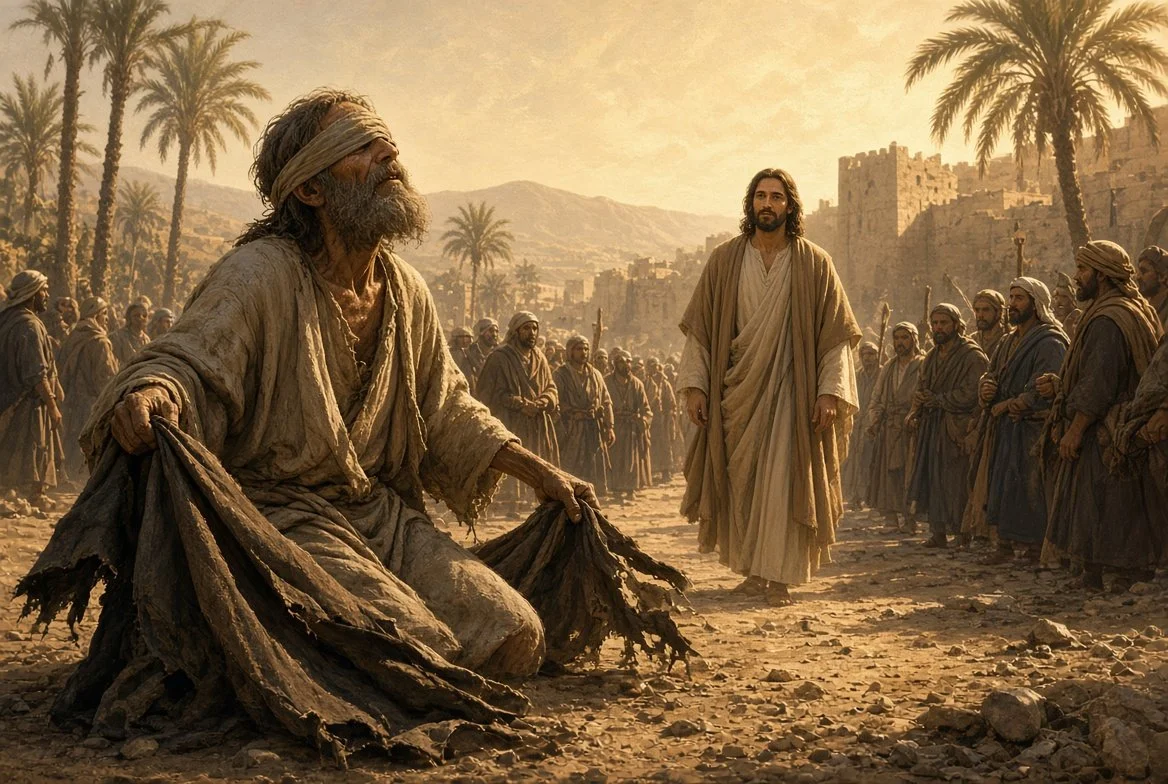
The road was full. Passover travelers filled the city, and the crowd moving with Jesus was loud enough that a man sitting in the dust could only catch fragments. Someone nearby said the name. Jesus of Nazareth was passing by.
The man did not use the name they gave him. He shouted a different one: “Jesus, Son of David, have mercy on me!”
Son of David was a throne title — the promised heir, the one who would reign forever. He could not see the faces, yet he named the Messiah. The people around him told him to be quiet. A beggar was only noise. He shouted louder. His cloak was still around him, the one thing he owned that kept the night off his back, and still he kept calling.
The Moment Everything Stopped
Jesus stopped.
In the middle of the press of people heading toward Jerusalem, He halted and ordered the man brought to Him. The beggar cast the cloak aside and came. Jesus asked him a question that still feels almost too plain for the one who asked it:
“What do you want me to do for you?”
“Lord, let me recover my sight.”
No other request. No argument about what he deserved. Just the clear need of a man who knew he could not help himself.
Jesus said, “Receive your sight; your faith has made you well.”
Sight returned at once. The man who had already named the Son of David now followed Him, glorifying God. The crowd that had tried to silence him joined the praise. John MacArthur points out that the word Jesus used is sōzō — the ordinary New Testament word for saved, not simply healed. Physical eyes opened, and a man was brought into the kingdom. The proof was immediate: he did not stay by the road collecting alms. He walked with Jesus.
The Last Public Miracle
This was the final major public miracle before the cross. From the wedding at Cana to this roadside near Jericho, Jesus had filled the land with signs. Now the Servant was about to become the suffering Servant. The light of the moment would soon give way to rejection, mockery, and death. Even so, on the way to that darkness, Jesus stopped for one more outcast.
MacArthur notes that faith is not always required for physical healing, but it is required for salvation. The man’s cry had already been a confession — he had nothing to offer and everything to receive. When Jesus declared that his faith had saved him, the following and the glorifying confirmed it. That is the mark of true conversion: leaving the old life and walking in obedience and worship.
The contrast a few verses earlier is sharp. Jesus had just told the Twelve that everything written about the Son of Man by the prophets would be fulfilled: He would be delivered over to the Gentiles, mocked, treated shamefully, spit on, flogged, killed, and rise on the third day. Luke says they understood none of it. The meaning was hidden from them, and they did not grasp what He said.
Then, almost immediately, a man who was physically blind is sitting by the roadside. He hears that Jesus is passing by and cries out, “Jesus, Son of David, have mercy on me!” He refuses to be silenced by the crowd. “Son of David” is a title for the promised Messiah. This man who cannot see recognizes who Jesus is, while the disciples who can see still do not understand what Jesus has just told them about His coming death and resurrection.
That is why the story notes that sight and blindness are not always where we expect them. Physical eyesight does not guarantee spiritual understanding, and physical blindness does not prevent someone from recognizing the Messiah.
When the King Comes Near
Most of us will never sit in the dust outside Jericho. The story still asks a direct question: When the King draws near, do we recognize Him? Do we cry for mercy, or do we assume we can manage?
There are those in the crowd who watch, marvel, and offer shallow praise. And there are those who, like the man by the road, abandon what they have and then follow. The first group may be impressed. The second group is saved.
Jesus still stops for those who cry out in genuine need. He still answers the confession that we are helpless and He is the Deliverer. The same mercy that opened eyes near Jericho opens eyes now. The pattern has not changed: cry out, trust, receive, and follow.
If you have been sitting in the dark — hearing the noise, knowing your need, not yet sure the King will stop for someone like you — the answer in Luke 18 is clear. He did. And He still does.