21 Myths Series: Myth 12 — Was Jonah Swallowed by a Whale?
Pop Culture & Everyday Myths (Myths 11–16)
What the Bible Actually Says vs. What Culture Thinks
Myth 12: “Jonah was swallowed by a whale.” → “Huge fish.”
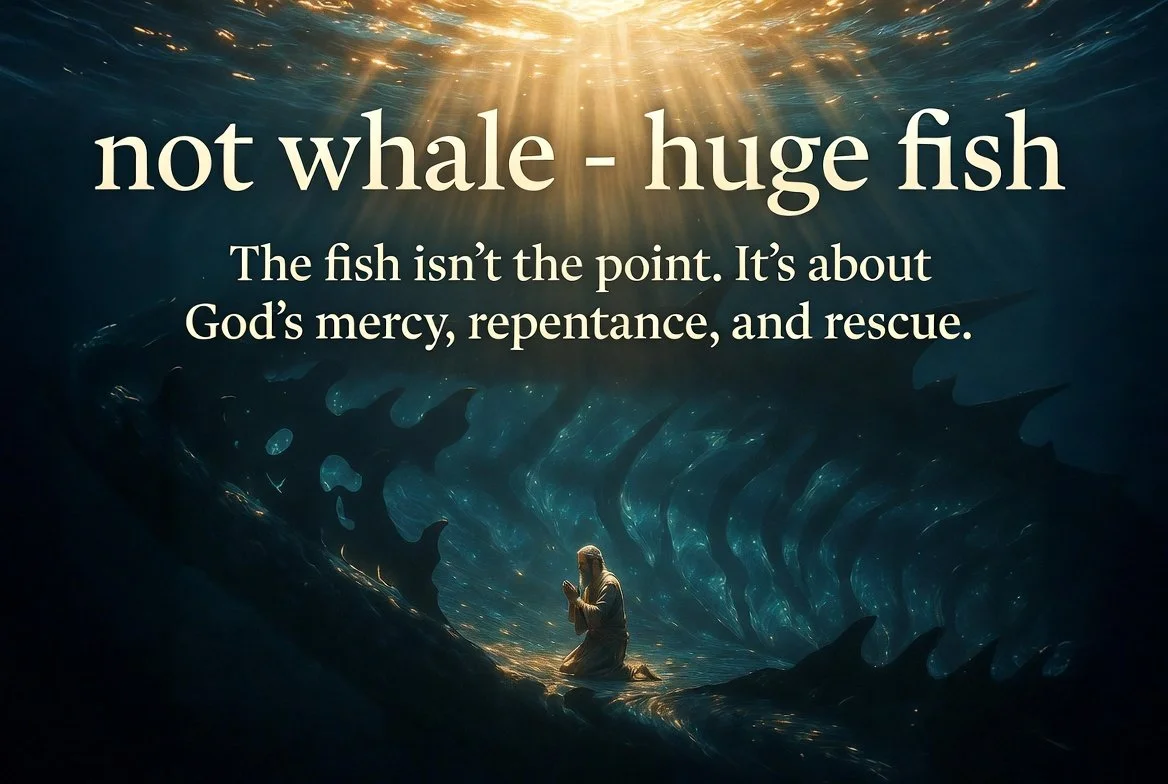
Pop culture loves the dramatic “Jonah and the Whale” tale. From cartoons and children’s books to Sunday school lessons and flannelgraphs, the image of a prophet inside a giant sperm whale has become shorthand for any unbelievable story. But the Bible never says “whale.” It clearly states that God provided a huge fish (or huge sea creature) to swallow Jonah, where he remained for three days and three nights (Jonah 1:17; Matthew 12:40).
What the Text Actually Says
The Hebrew phrase in Jonah 1:17 is dag gadol - “great fish” or “large sea creature.” The New Testament Greek in Matthew 12:40 uses kētos, often translated “whale” in older versions but more broadly meaning a huge sea monster or marine animal. Ancient Hebrews didn’t use modern biological categories distinguishing fish from marine mammals; “fish” could cover large aquatic creatures.
Commentators like John MacArthur point out that the specific Hebrew term for whale isn’t used, suggesting it wasn’t necessarily a warm-blooded mammal. This detail heightens the miraculous nature: God supernaturally prepared this creature to rescue Jonah from drowning and sustain him in a cold, dark, suffocating environment.
The fish itself is memorable but secondary. The true hero is the God who commands the sea, pursues runaways, and offers second chances. Culture fixates on the whale; Scripture points us to the Redeemer.
Why Culture Gets It Wrong—and Why Precision Matters
The “whale” detail often fuels skepticism: “How could anyone survive in a whale’s stomach?” Critics zero in on biology — stomach acid, oxygen, size — while overlooking the miracle. The Bible doesn’t conceal the impossibility; it showcases God’s power to preserve life in the depths.
Jonah 2 vividly describes Jonah’s near-death experience, a hopeless despair, and his eventual deliverance through prayer. The real focus isn’t marine biology but rebellion, repentance, and God’s mercy.
Jonah fled God’s call to preach repentance to the hated Ninevites in brutal Assyria’s capital. The great fish served as both judgment and salvation — Jonah’s “tomb” became a place of recommissioning. Jesus affirmed the account as historical and prophetic: “For as Jonah was three days and three nights in the belly of the huge fish, so will the Son of Man be three days and three nights in the heart of the earth.” (Matthew 12:40). The story foreshadows Christ’s death and resurrection.
Why This Matters Today
This myth-busting truth carries powerful applications:
Miracles aren’t optional. Dismissing the great fish weakens confidence in God who raises the dead — the greater sign Jesus highlighted.
Obedience over preference. Jonah’s reluctance and prejudice mirror our resistance to God’s uncomfortable calls. God still uses flawed people.
God’s mercy is wider than we prefer. Nineveh’s repentance (the largest revival in the Old Testament) exposed Jonah’s hard heart. Grace often offends the self-righteous.
It points to Jesus. The story isn’t mainly about a fish — it’s about resurrection hope and a God who relentlessly pursues runaways.
Conclusion
The Jonah and the whale story — properly understood as Jonah and the great fish — reminds us that God’s power far exceeds our understanding. What culture turns into a children’s cartoon or skeptical punchline is actually a profound account of divine mercy, repentance, and redemption. It challenges us to stop running from God’s call and trust His ability to rescue and restore.
Whether you’re exploring Bible myths, seeking answers to common objections, or deepening your faith, the Book of Jonah invites you to move beyond the fish and fix your eyes on the sovereign God who saves. The same God who prepared a great fish for Jonah sent His Son for you.
This is Myth 12 in my 21 Myths Series: Pop Culture & Everyday Myths (Myths 11–16).
Previous:
Myth 11 — Is Money the Root of All Evil?
Reliable Voices on This Topic
John MacArthur / Grace to You (gty.org): Detailed sermons and blogs on Jonah emphasizing the supernatural preparation of the fish and the greater miracle of repentance.
Folsom Bible Church: Series on God’s mercy in Jonah.
Apologetics resources (e.g., Wes Huff, GotQuestions, Answers in Genesis): Address historical and textual details.
Primary text: Jonah 1–2; Matthew 12:38–41; cross-referenced with historical context on Nineveh.