Jeremiah’s Prophecy of the New Covenant Fulfilled by Jesus
Jeremiah stood in the wreckage of a covenant already broken. Jerusalem’s walls still stood, but the nation’s heart had collapsed under idolatry, injustice, and ritual that no longer touched the soul. Exile was coming. Into that ruin the Lord spoke a promise that would outlast Babylon and every empire after it:
“‘Behold, the days come,’ says Yahweh, ‘that I will make a new covenant with the house of Israel, and with the house of Judah, not according to the covenant that I made with their fathers in the day that I took them by the hand to bring them out of the land of Egypt, which covenant of mine they broke, although I was a husband to them,’ says Yahweh. ‘But this is the covenant that I will make with the house of Israel after those days,’ says Yahweh:
’I will put my law in their inward parts,
and I will write it in their heart.
I will be their God,
and they shall be my people.
They will no longer each teach his neighbor,
and every man teach his brother, saying, ‘Know Yahweh;’
for they will all know me,
from their least to their greatest,’ says Yahweh,
’for I will forgive their iniquity,
and I will remember their sin no more.’”
This was no minor revision. The earlier covenant had been written on stone. It revealed God’s holy standard with perfect clarity, yet human hearts stayed hard. The people broke it repeatedly. The new promise was different in kind: God Himself would write the law inside His people, grant intimate knowledge of Himself to every person from the least to the greatest, and deal with sin by full forgiveness — sins remembered no more.
From Prophecy to the Upper Room
Roughly six centuries later, on a Passover night in Jerusalem, the promise took concrete form.
Jesus reclined with His disciples at the meal that remembered Israel’s deliverance from Egypt. He took bread, gave thanks, broke it, and said, “This is my body which is given for you. Do this in memory of me.” Then He took the cup after supper and declared: “This cup is the new covenant in my blood, which is poured out for you.” (Luke 22:19-20).
In that room, hours before the cross, Jesus was not simply sharing a symbolic meal. He was inaugurating the covenant Jeremiah had foreseen. The blood of Passover lambs had once marked doorposts for temporary rescue. The blood of the true Lamb would seal an everlasting covenant that brings complete forgiveness and a transformed heart. Paul would later transmit the same words as tradition he himself received (1 Corinthians 11:25), and the author of Hebrews would quote Jeremiah 31 at length to show that Christ’s once-for-all sacrifice rendered the old sacrificial system obsolete (Hebrews 8:8–13; 10:16–17).
What Makes the New Covenant New
Jesus brought the old Passover to its fulfillment and opened something greater. Ancient covenants were sealed with blood; here He offered His own. The cup, once tied to the blood of animals, now represented His blood poured out for the forgiveness of sins.
The new covenant is pure grace. It is no longer a system of external conformity and repeated sacrifices, but God’s unilateral promise — “I will… I will… I will…” — written on the heart by the Spirit. What is new is not the absence of God’s ways, but the promised new heart and the Spirit’s enabling power so that love for God rises from within. The same problem that once left people unable to keep the law is now met by God Himself changing the heart.
Those who examine the historical foundations of the Gospels note that the accounts of this night rest on early testimony and careful transmission. The continuity from Jeremiah’s prophecy to Jesus’ words in the upper room is part of a coherent narrative that runs from the prophets through the earliest Christian tradition. Wes Huff explores these historical foundations in his course at Peterson Academy, showing how the textual and historical evidence supports the reliability of the story from the weeping prophet to the cross.
Living in the New Covenant Today
Under the new covenant, believers no longer approach God solely through external rituals or distant mediators. Through Christ, the great High Priest, every person has direct access. Sins are forgiven and forgotten. The Spirit writes God’s ways on the heart so that obedience becomes the glad response of a transformed life.
The same faithful God who created and covenanted from the beginning is the One who keeps His promises across the ages. This covenant of grace changes everything.
The story did not end in the upper room. The next day Jesus poured out His blood on the cross, sealing the covenant. Three days later He rose, proving its power. And today, every time believers take the bread and the cup, they proclaim that death until He comes. They share in the ongoing reality of a covenant that writes God’s law on the heart and remembers sins no more.
What does this mean for us? The same invitation that went out that night still stands. Through faith in Jesus, anyone — least or greatest — can know the Lord, receive full forgiveness, and experience the Spirit’s transforming work.
Jeremiah spoke in the shadow of exile. Jesus spoke on the night of betrayal. Yet both pointed to the same unbreakable promise. The God who said “I will” has done it. The law is written on hearts. Sins are remembered no more. We are His people, and He is our God.
Come to the table. Remember. Believe. Live in the freedom of the new covenant sealed in the blood of the Lamb.
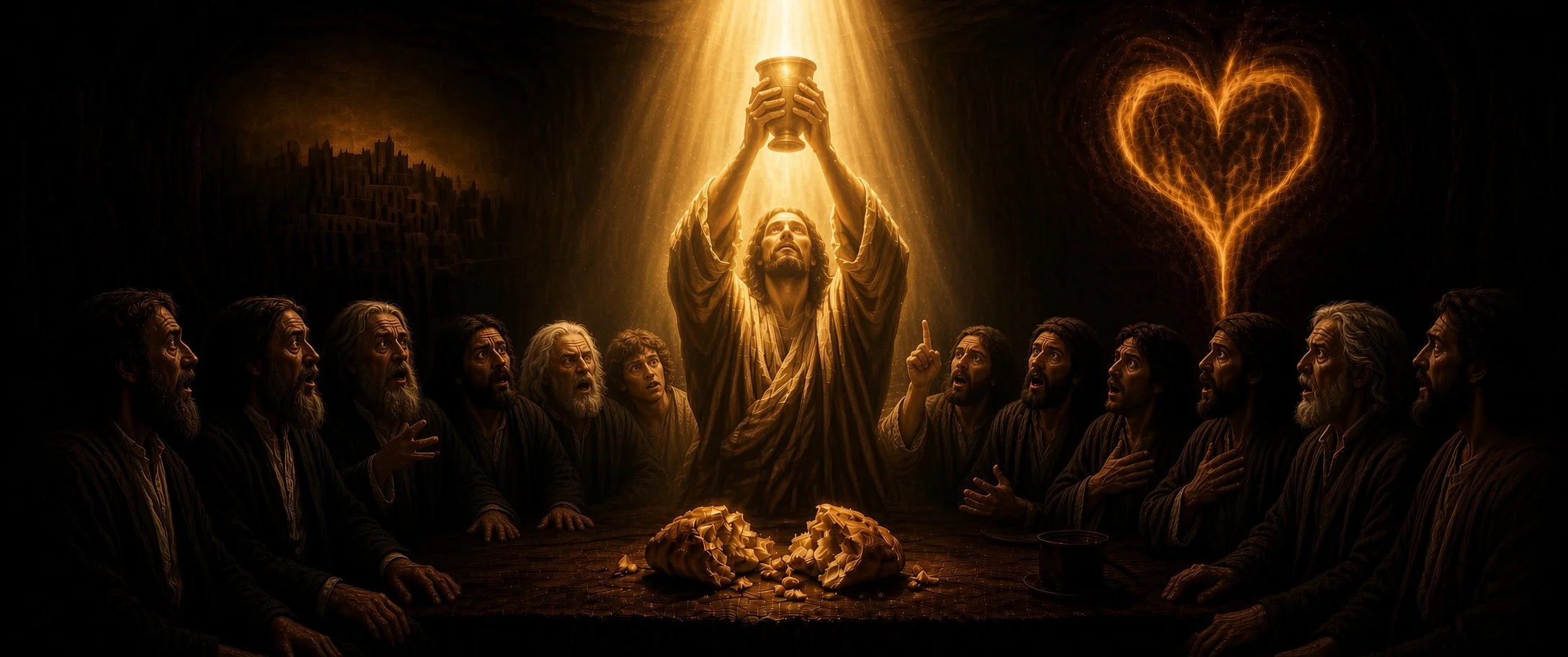
The Last Supper