The Kingdom Hidden in the Dough
A woman takes a scrap of living dough and buries it in a mass of flour large enough to feed a feast. Nothing looks different. By morning the whole batch has changed.
Jesus said the kingdom is like that.
He said it in Galilee, among people still waiting for a Messiah to break Rome. The kingdom does not start the way they expected. It arrives as something tucked inside ordinary life and left to work.
Full Scripture Passage
Matthew 13:33
He spoke another parable to them. ‘The Kingdom of Heaven is like yeast which a woman took and hid in three measures of meal, until it was all leavened.’
Luke 13:20-21
Again he said, “To what shall I compare the Kingdom of God? 21 It is like yeast, which a woman took and hid in three measures of meal, until it was all leavened.”
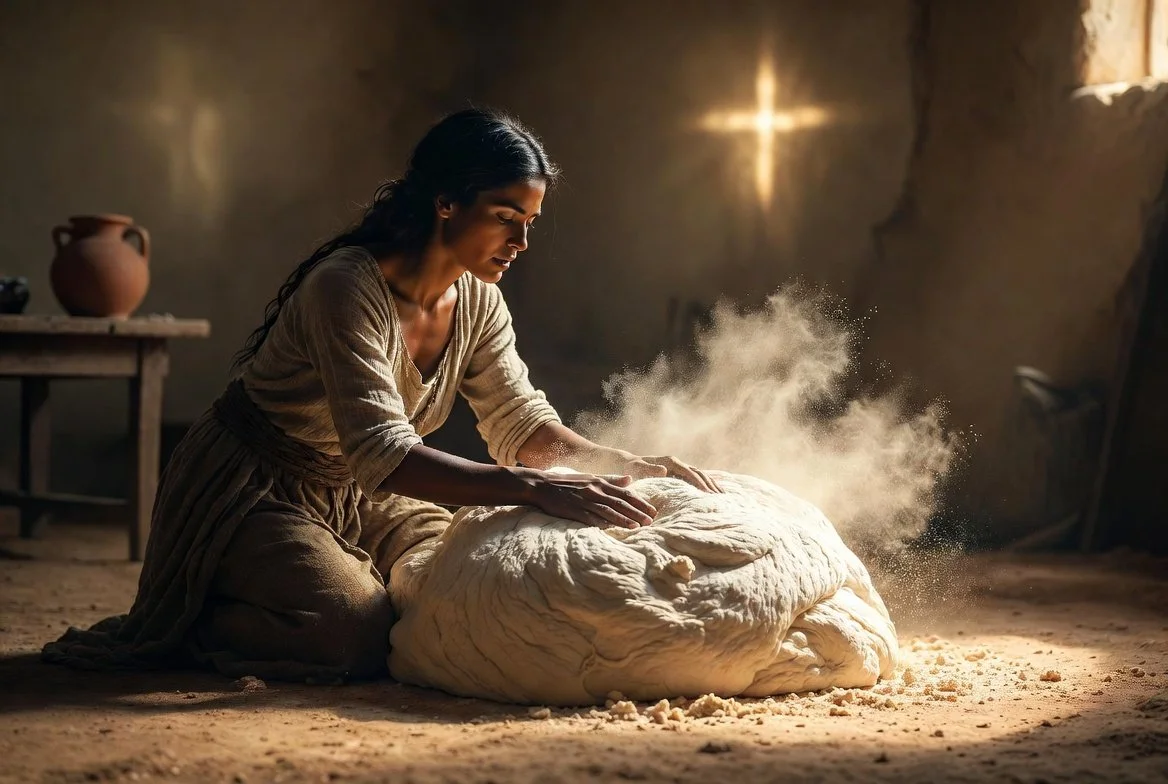
The Parable of the Leaven
The image is stranger than it first appears
First-century leaven was a reserved lump of fermented dough — starter — worked into fresh flour. It was small. It was alive.
Jesus does not compare the kingdom to incense, oil, or temple bread. He compares it to the thing you hide in the trough and wait on. The holy work looks like fermentation.
“Three measures” is not supper for one house. It is on the order of fifty pounds of flour — feast-scale. Sarah used three seahs when the Lord appeared at Abraham’s tent (Genesis 18:6). Gideon and Hannah offer in the same register. The amount already hints at guests. The woman does not dust the surface. She hides the starter in the mass. Concealment, time, then a finished result: the whole is leavened.
Mustard seed and leaven are one pair
This parable sits with the Parable of the Mustard Seed. The mustard seed is growth you can point at — from almost nothing to a plant large enough for birds. The mustard seed is size. The leaven is permeation.
Together they describe a kingdom that does not start impressive and does not stay confined to what first meets the eye.
What it claims
The kingdom begins out of proportion to its effect.
It is placed inside what it touches.
It works until the process is complete — “until it was all leavened.”
It does not promise that every person will believe, that history will improve on our calendar, or that hidden work will feel successful while it is happening. The woman hides. The batch is leavened. God finishes.
What it is not
This is not “be a quiet positive influence.” That turns a claim about God’s reign into a personality tip. It is not a strategy for cultural capture. It is a description of how the kingdom moves: from the inside, over time, often without spectacle, toward a completion God has already named.
Small and hidden does not mean absent. Obvious and large does not mean finished.
What it asks
If you belong to that kingdom, you are already in the dough. Not as the one who makes it rise, but as part of what was hidden there: the gospel taking hold in people, households, and places.
You do not make the batch rise on cue. Stay with the word in ordinary life. If the change is still hard to see, that is not proof the work has failed. The parable said it would start hidden.
The hope is not that your effort will look like a triumph. The hope is that what has been hidden is already at work, and God will finish what he began.
Quick Answers
Main point? The kingdom starts small and hidden. It works from the inside until the whole is changed.
Why leaven? A scrap of starter quietly transforms a feast’s worth of flour. Jesus chose an image that spreads from within so the kingdom’s way of working would not be confused with a public triumph.
Does this mean the whole world will become Christian? No. The parable teaches how the kingdom works, not that every person will believe. Wheat and weeds grow together until the harvest.
How can I be “leaven” right now? You are not the baker. Stay with the gospel in ordinary places. Do not treat a hidden beginning as a failed one.
What hope does this give when the kingdom feels small? Hidden is how Jesus said it would start. What has been put in the dough is already at work, and God finishes what he began.