21 Myths Series: Myth 3 — Was the Bible Written Centuries After the Events?
Transmission & Canon Myths (Myths 1–5)
Was the Bible Written Centuries After the Events? Myths About Bible Reliability and Origins
Myth 3: “The Bible was written centuries after the events.”
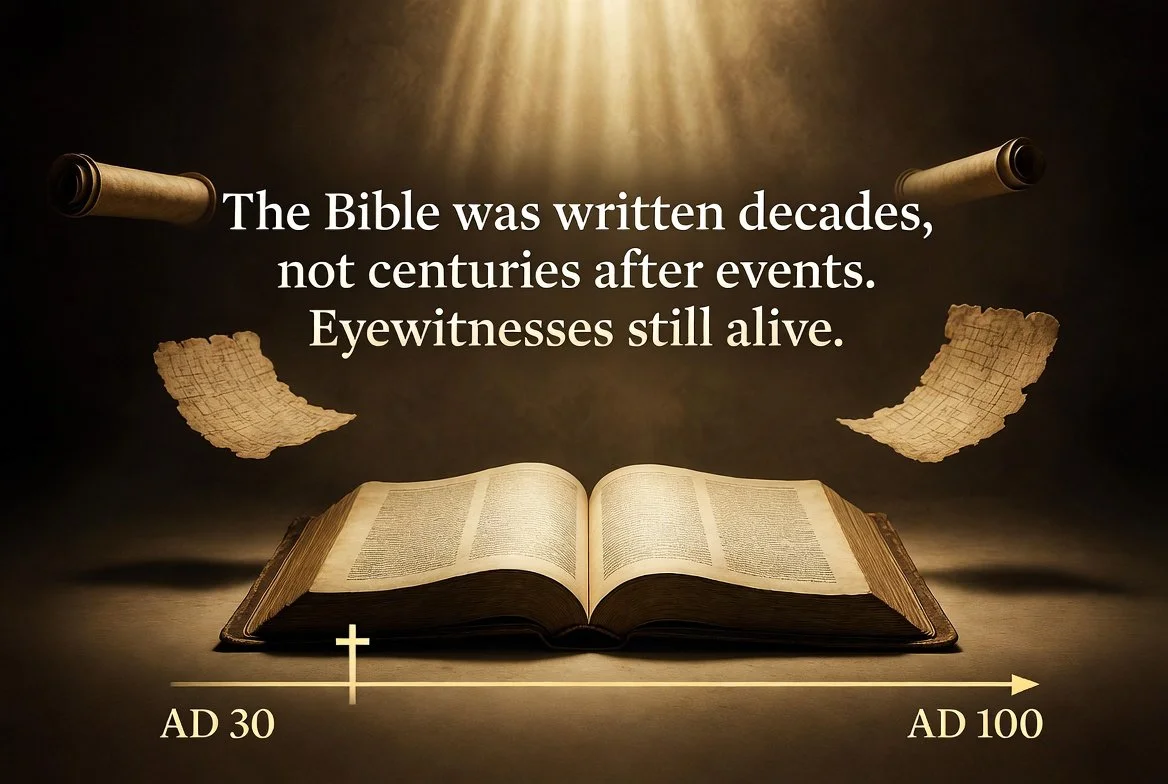
A common objection claims: “The Bible was written centuries after the events, so legends and myths crept in — turning Jesus, a teacher, into a divine figure.” This myth suggests the New Testament (especially the Gospels) emerged in the 2nd or 3rd century AD. But the historical evidence shows the opposite: the entire New Testament was written within decades of Jesus’ life (AD 30–33), while eyewitnesses were still alive. The Old Testament also rests on strong early foundations.
The objection often lumps the entire Bible together, but the Old Testament (Hebrew Bible) spans a much longer period of composition — roughly 1400–400 BC — than the New Testament. Critics sometimes claim later dates for key books (e.g., pushing Daniel or parts of the Pentateuch into the 2nd century BC or later) to suggest legendary development or post-event fabrication. However, the evidence supports substantial early authorship, careful transmission, and remarkable textual stability over centuries.
Why the “Written Too Late” Myth Persists
Critics argue there was plenty of time for exaggeration and legendary development. In reality, the New Testament was composed in the mid-to-late 1st century AD (roughly AD 50–100) — far too early for widespread myth-making in a culture with living eyewitnesses who could correct errors.
New Testament Timeline – Written Within Living Memory
Conservative and many mainstream scholars date the books as follows:
Paul’s Letters (earliest writings):
Galatians (~AD 49), 1–2 Thessalonians (~AD 51), 1 Corinthians (~AD 55), Romans (~AD 57).
These include early creeds like 1 Corinthians 15:3–7, which many scholars date to within 2–5 years of the crucifixion.Gospels:
Mark (Late 30s AD… ~AD 50–60), Matthew (Late 40s AD… ~AD 50–70), Luke (~AD 60–80), John (~AD 80–95).Other books: James (~AD 44–49), Revelation (~AD 94–96).
Key Point: The entire New Testament was completed within 20–70 years of Jesus’ ministry — in the same region where events occurred — far too soon for widespread legendary development in a culture with living eyewitnesses who could correct errors. As apologist Wes Huff and others note, the rapid circulation of these texts across the Roman Empire further supports an early origin.
Old Testament – Closer to Events Than Most Realize
While the Old Testament spans a longer period (roughly 1400–400 BC), most books were written by participants or near-contemporaries:
Pentateuch: Core tied to Moses (~1400–1200 BC)
Historical books: Compiled from court records during or soon after events
Prophets: Largely written during the reigns they describe (8th–6th centuries BC)
Psalms & Proverbs: Many from David (~1000 BC) and Solomon (~950 BC)
The Old Testament was largely complete by the time of Ezra/Nehemiah (~450–400 BC), with the canon recognized well before the 3rd–2nd centuries BC. Even critical scholars often acknowledge that large portions reflect earlier sources, though they debate exact dates. The gap for most books is decades to a couple of centuries at most — not “centuries after” in a way that allows unchecked myth-making.
Manuscript Evidence Confirms This Early Origin
Physical copies strongly support these early composition dates:
The John Rylands Papyrus (P52), a small fragment of John 18, is dated to approximately AD 125–150. This shows that John’s Gospel was already being copied and circulated in Egypt within just a few decades of its original writing.
Other early papyri preserve large portions of the New Testament (including substantial sections of the Gospels, Acts, and Paul’s letters) and date from the late 2nd to early 3rd centuries AD (roughly AD 175–250). These manuscripts demonstrate that the New Testament books were already widely copied and distributed across the Roman Empire just 100–150 years after they were first written.
The Dead Sea Scrolls (discovered 1947–1956) are the game-changer. These ~900 manuscripts (250 BC–AD 68) include fragments or copies of every Old Testament book except Esther. They predate previous complete Hebrew manuscripts (Masoretic Text, ~AD 900–1000) by about 1,000 years.
Great Isaiah Scroll (c. 100 BC): Nearly identical to the later Masoretic version. In Isaiah 53 (166 words), only minor spelling or stylistic differences appear — one word of three letters in question, not affecting meaning.
Overall: Over 95% identity with modern texts; variants are mostly minor (spelling, conjunctions) and do not change core doctrines or narratives.
Compare this to other ancient works (e.g., many of Plato’s or Tacitus’ writings survive only in copies from centuries later). The New Testament has an extraordinarily short gap between events and manuscripts.
Other early witnesses:
Septuagint (Greek translation, c. 250–150 BC): Confirms the Hebrew text existed in stable form centuries earlier.
Ketef Hinnom silver scrolls (c. 600 BC): Contain the priestly blessing from Numbers 6:24–26 — the oldest known biblical text.
This demonstrates meticulous scribal transmission. Jewish copyists followed rigorous rules, treating the text as sacred.
Eyewitness Testimony and Internal Evidence
The New Testament texts themselves claim proximity to events:
Luke 1:1–4 emphasizes careful investigation from “eyewitnesses and servants of the word.”
John 19:35 and 21:24 stress the author’s (or his source’s) firsthand knowledge.
The authors name specific people, places, customs, and details (e.g., names matching 1st-century Jewish patterns in Galilee/Judea) that align with archaeology and external records — details a later forger would likely get wrong.
Living eyewitnesses (including hostile ones) in Jerusalem and surrounding areas would have challenged fabrications. The early church faced persecution; fabricating a risen Messiah offered no political or social gain.
Many sections of Old Testament claim or imply near-contemporary recording:
Moses as eyewitness/participant in Exodus–Deuteronomy.
Prophets writing during the reigns of kings they confronted.
Detailed knowledge of geography, customs, and politics matches archaeology (e.g., kings lists, sieges, daily life in Israel/Judah).
External confirmations from Assyrian, Babylonian, and Persian records align with the sequence and details in Kings/Chronicles. While not every event has direct extra-biblical proof (expected for ancient history), the overall framework holds up well.
Why the “Centuries Later” Claim Fails
New Testament: Decades, not centuries — within living memory.
Old Testament: Many books were written by participants or near-contemporaries, then faithfully transmitted. The gap is comparable to (or better than) other accepted ancient histories like Herodotus, yet with far more manuscript support and textual consistency.
Legends typically need generations of distance and lack of eyewitness correction. The Bible had neither. The short transmission gaps, abundance of manuscripts, and historical corroboration refute late-legend theories.
The Bible reflects real events recorded and preserved by people who believed they were encountering God in history. This foundation — early composition + careful transmission — supports its reliability as both a historical document and a theological witness.
Why This Matters: No Time for Legend
Legends typically need 100+ years and distance from events. The Bible had neither. The short time gap, abundant manuscripts, and eyewitness foundation mean the New Testament reflects genuine testimony — not centuries-later myth-making. The early dating means original witnesses were available both to write and to correct falsehoods.
The New Testament wasn’t a product of centuries-later myth-making. It reflects immediate, eyewitness-driven testimony that spread rapidly because early Christians believed it was true — and staked their lives on it. This foundation reinforces the reliability of the text we have today.
For events in the distant past (e.g., Exodus), the gap is longer than the New Testament’s — but still comparable to (or better than) other ancient histories like Herodotus or the Epic of Gilgamesh, which we accept despite larger gaps and fewer copies. The Old Testament’s multi-author, centuries-long composition shows remarkable unity, preserved through exile and diaspora by committed scribes.
Conclusion
The claim of “centuries after” doesn’t hold uniformly. Much of the Old Testament was written near the events by participants or contemporaries, then faithfully copied. Combined with the New Testament’s even tighter timeline, the Bible as a whole rests on strong historical foundations rather than late myth-making. This reliability extends to its theological message: God acting in real history.
This is Myth 3 in our 21 Myths Series: Transmission & Canon (Myths 1–5).
Previous:
Myth 1 – Has the Bible Been Changed?
Myth 2 – Did Constantine Create the Bible?
Reliable Voices on This Topic
John MacArthur: He dates books like James to AD 44–49 and the Gospels to the 50s–80s, emphasizing their eyewitness roots and historical reliability in his commentaries and teachings.
Wes Huff: Focuses on manuscript dating, early church testimony, and why criteria like names, geography, and rapid circulation point to 1st-century origins.
Charlie Kirk: In campus discussions, he highlights the short time gap, manuscript abundance (over 5,800 Greek copies), and lack of legendary development as evidence for reliability.
Josh Howerton: Similar emphases on early dating dismantling “legend” theories.