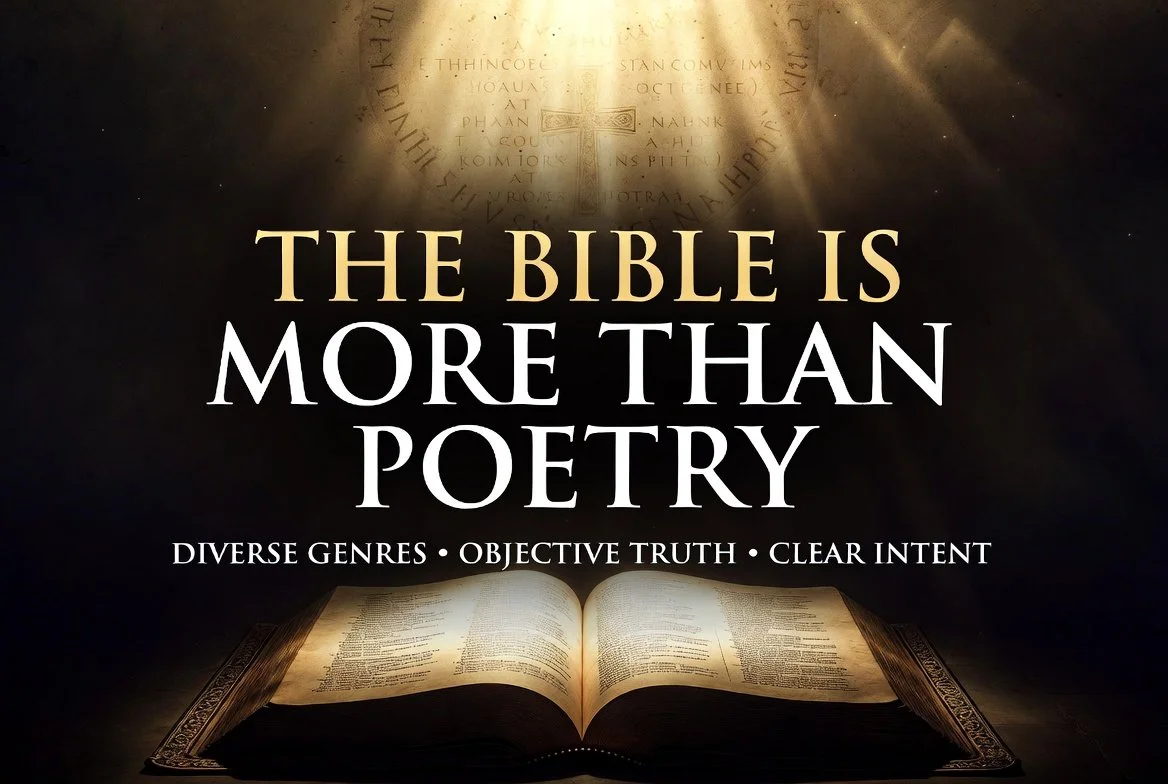
21 Myths Series: Myth 5 — Is the Bible Just Poetry Open to Interpretation?
Transmission & Canon Myths (Myths 1–5)
Is the Bible Just Poetry Open to Interpretation? Myths About Bible Reliability and Origins
Myth 5: “The Bible is only poetry and up to individual interpretations.”
One of the most common modern myths claims: “The Bible is only poetry and up to individual interpretations — any reading is as valid as another.” This reduces Scripture to subjective art or personal feelings. In reality, the Bible is a rich library of diverse literary genres written with clear intent to communicate objective truth about God, history, and redemption.
Why the “The Bible is only poetry open to interpretation“ Myth Persists
Treating the Bible as subjective poetry allows people to dismiss uncomfortable truths, proof-text for personal agendas, or accommodate culture. Postmodern culture teaches that truth is relative and all interpretations are equally valid. Many people only encounter the poetic parts (Psalms, Proverbs, or prophetic imagery) and assume the whole Bible works the same way. Skeptics and progressive voices use it to dismiss the Bible’s historical claims or moral authority without engaging its actual content.
As a result, the Bible is treated like a mirror for personal feelings rather than God’s authoritative Word.
The Bible Is Far More Than Poetry
The Bible contains beautiful poetry — roughly one-third of the Old Testament, including the books of Psalms, Proverbs, and Song of Songs, along with extensive poetic sections in the Prophets. Yet it is far more than poetry.
The Bible is traditionally organized in the canonical structure into major sections such as Law, History, Poetry/Wisdom, and Prophets in the Old Testament, followed by Gospels, History, Epistles, and Prophecy in the New Testament. These sections overlap with the Bible’s primary literary genres, which describe how the text is written and how it should be read:
Major literary genres include:
Historical narrative (Genesis–Esther, the Gospels, Acts) records real events, people, places, and timelines.
Law (Exodus–Deuteronomy) delivers delivers God’s binding covenant commands and instructions for His people.
Poetry and Wisdom (the dedicated Poetry/Wisdom section — Job-Song of Songs — plus poetic passages throughout the Prophets) expresses worship, emotion, proverbs, and human experience through vivid imagery and parallelism.
Letters (Epistles) (Romans–Jude) offer direct doctrinal teaching and ethical instruction to specific churches and individuals.
Prophecy and apocalyptic (Daniel, Revelation) declare God’s sovereign plans, warnings, promises, and ultimate victory.
Treating Genesis 1–11, the Exodus, or the resurrection accounts in the Gospels as “just poetry” ignores their deliberate structure as factual reporting. Wes Huff stresses: “Genre is VERY important when it comes to scripture. You’re going to have to read Leviticus differently than the book of Acts.” Honoring genre treats the text with seriousness, not diminishes it. Books often layer genres (history with embedded poetry or laws), making genre awareness even more essential.
Calling everything “poetry” flattens these distinctions and evades the text’s claims about reality. The Bible is not a collection of myths or moral fables but a reliable record that has shaped civilizations precisely because it claims — and delivers — truth about reality.
Interpretation Is Not Purely Subjective
The claim that “it’s all up to individual interpretation” promotes postmodern relativism. While personal application can vary, the core meaning is anchored in the author’s intent, historical context, and literary genre — not whatever the reader feels.
Proper interpretation (hermeneutics) follows these steps:
Identify the genre
Study the historical and cultural context
Determine the author’s (and God’s) intended meaning through grammatical-historical exegesis
Compare with the rest of Scripture (analogy of faith)
Apply faithfully today
John MacArthur emphasizes: “The meaning of Scripture is what God intended to say.” We draw meaning out of the text rather than reading our ideas into it. We must ask, “What did God intend to say?” not “What does this mean to me?”
Proper interpretation begins with honoring the biblical author’s intent, historical setting, and literary genre. Genre awareness treats the text seriously rather than diminishing it. The Bible’s human authors communicated specific messages under God’s inspiration. There is one primary intention per text (though multiple applications), discerned through diligent study.
The Bible’s Unified Message
Despite 40+ authors across 1,500+ years, the Bible tells one cohesive story centered on Jesus Christ. Josh Howerton often shows how Jesus Himself (Luke 24) taught that the entire Old Testament points to Him. This Christ-centered unity gives the Bible remarkable clarity on essential matters.
Reading the Bible this way reveals its unified story without turning it into subjective poetry. The New Testament explicitly interprets the Old in light of Christ — giving us the authoritative lens.
Why This Myth Is Dangerous and What’s at Stake
Treating the Bible as “just poetry up for grabs” dodges its authority. Ignoring genre and intent leads to chaos — proof-texting, cultural accommodation, or dismissing uncomfortable truths as “metaphor.” Proper interpretation demands diligence, humility, and submission — leading to transformation.
It is a reliable record of God’s redemptive acts in history, culminating in Jesus Christ. The Bible has not been “changed” into relativism. Its message stands firm. Those who approach it on its own terms encounter the living God who speaks clearly through His Word.
Why This Matters
This myth ultimately leads to spiritual confusion and cultural chaos. A clear, objective Bible gives us a solid foundation. A relativistic “poetry” Bible leaves us with nothing but shifting opinions.
This myth falls apart when the Bible is allowed to speak for itself. Read it diligently, interpret it rightly, and let it transform you.
Conclusion
When we approach the Bible on its own terms — respecting genre, context, and authorial intent — we encounter the living God who speaks clearly. The Bible is not a relativistic mirror but a reliable revelation of truth.
This is Myth 5 in our 21 Myths Series: Transmission & Canon (Myths 1–5).
Previous:
Myth 1 – Has the Bible Been Changed?
Myth 2 – Did Constantine Create the Bible?
Myth 3 – Was the Bible Written Centuries After the Events?
Myth 4 – Were Lost Gospels Suppressed?
Reliable Voices on This Topic
Wes Huff (Apologist and textual scholar / wesleyhuff.com): Strongly emphasizes honoring the biblical author’s intent, historical setting, and literary genre. His work on biblical reliability and proper interpretation is excellent. Highly recommended articles and lectures on “Can I Trust the Bible?”
John MacArthur (Grace to You / gty.org): One of the clearest modern teachers on hermeneutics — the science of biblical interpretation. He insists on grammatical-historical exegesis that draws meaning out of the text rather than reading personal ideas into it. Search sermons like “Proper Biblical Interpretation” and “How Should We Interpret the Bible?”
Josh Howerton (Senior Pastor, Lakepointe Church): Excellent at showing how the whole Bible tells one unified story centered on Christ. His preaching models Christocentric, genre-sensitive exposition. Check his sermons and Live Free podcast.
Charlie Kirk: Passionately defends the Bible’s historical reliability, unity, and transformative power against skeptical attacks. Great for cultural and apologetic conversations.
Folsom Bible Church (folsombiblechurch.org): A strong local model of consistent, expository preaching that works through books of the Bible verse-by-verse while respecting genre and context.