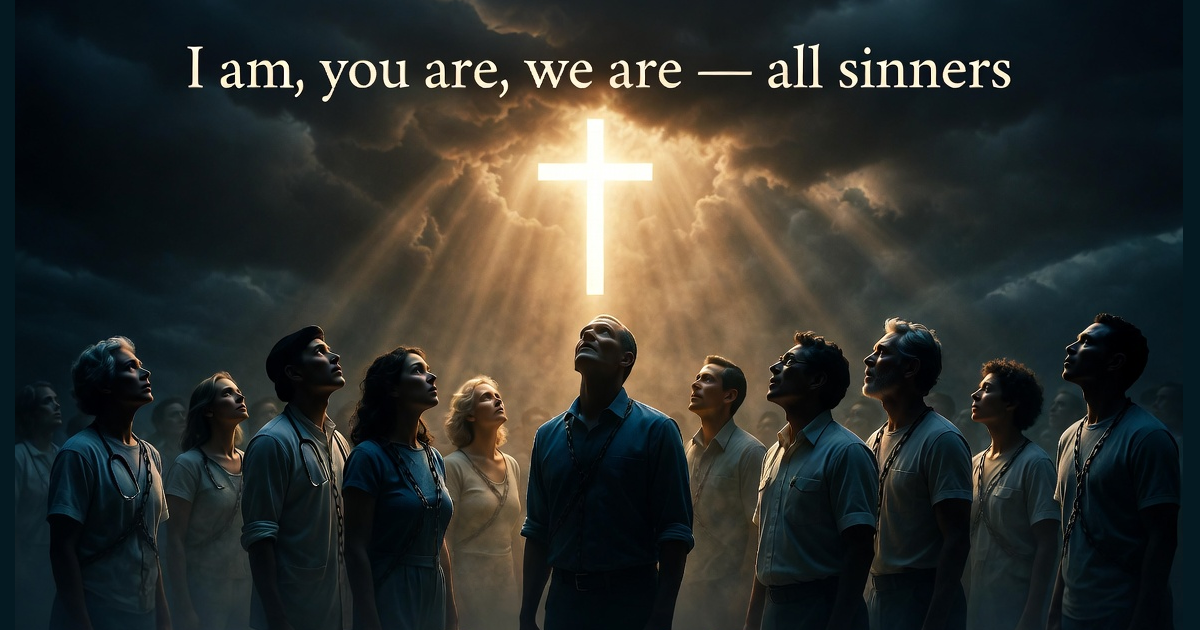
We Are All Sinners: The Uncomfortable Truth That Points Us to Grace
You watch someone else sin, and the thought comes quickly: “I’m not that bad.” Then another: “At least I’m not like them.”
The Bible has a different diagnosis — one that levels every single one of us.
I am… you are… we are… all sinners.
That sentence is not popular. It is still where the gospel begins. And when you finally accept it, it does not crush you. It tells the truth, then points you to grace.
What the Bible Says
The clearest statement comes from the Apostle Paul: “for all have sinned, and fall short of the glory of God;” — Romans 3:23. Not some. Not the people who struggle more than you. All.
Earlier in the same chapter he quotes the Old Testament: “As it is written, ‘There is no one righteous; no, not one.’” — Romans 3:10.
King Solomon put it this way centuries earlier: “Surely there is not a righteous man on earth who does good and doesn’t sin.” — Ecclesiastes 7:20.
And the apostle John warns believers: “If we say that we have no sin, we deceive ourselves, and the truth is not in us.” — 1 John 1:8.
The Bible doesn’t let anyone off the hook — not the religious, not the “good person,” not you, and not me.
Where It Started
Sin didn’t start with your bad choices. It started with one man — Adam — and it spread to every person born after him.
“Therefore, as sin entered into the world through one man, and death through sin, so death passed to all men because all sinned.” — Romans 5:12
The whole creation still feels that wound. Sin is not only the wrong things we do. It is a condition. It reaches the mind, the will, the emotions, and the body. It reaches every corner of the world.
It means sin has touched every part of us. We cannot save ourselves. We cannot earn God’s favor. Apart from His grace, we are spiritually dead.
God saves only sinners. Salvation is not offered to the self-righteous or the “pretty good.” It is for the ungodly. It is for sinners.
Wes Huff, apologist, has said it plainly in interviews: “Everybody is going to hell” without Jesus — because “no one is good but God alone.” Heaven isn’t filled with good people; it’s filled with people who know they aren’t good enough.
So What Do We Do?
This truth is uncomfortable because it destroys every excuse and every ladder we try to climb to God.
But here’s the beautiful part: The gospel is only good news to sinners.
Jesus didn’t come for the healthy — He came for the sick (Mark 2:17). He didn’t die for the righteous — He died for the ungodly (Romans 5:6).
When we finally say, “I am a sinner", we stop pretending and start receiving.
We stop trying to clean ourselves up enough for God and instead run to the only One who can wash us clean.
The Hope That Follows the Diagnosis
The same Bible that declares our universal guilt also declares our universal offer of grace:
“being justified freely by his grace through the redemption that is in Christ Jesus,” — Romans 3:24
We don’t have to stay in denial. We don’t have to compare yourself to others. We can simply agree with God: “Yes, Lord. I have sinned and fall short.”
And in that honest confession, we find the arms of the Savior wide open.
We are all sinners.
That’s the bad news that makes the good news really good.
The gospel isn’t about becoming good enough — it’s about being rescued by the One who is perfectly good.