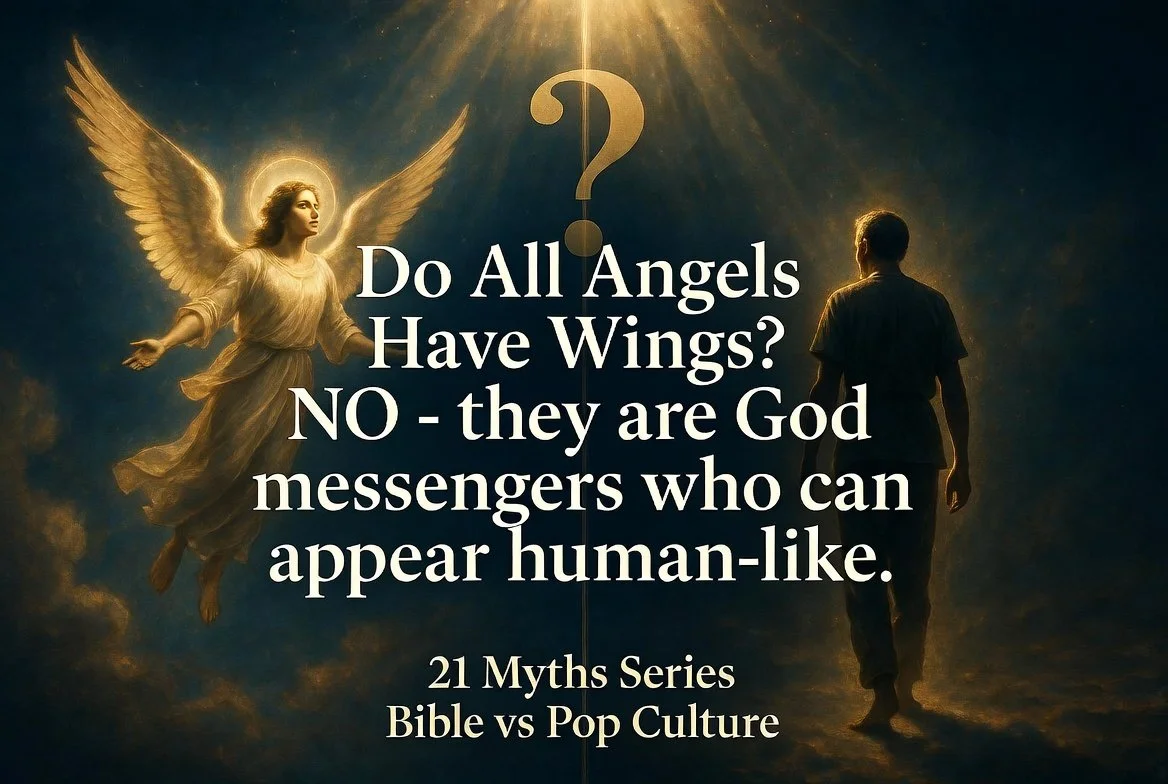
21 Myths Series: Myth 15 — Do All Angels Have Wings?
Pop Culture & Everyday Myths (Myths 11–16)
What the Bible Actually Says vs. What Culture Thinks
Myth 15: “All angels have wings.” → Messengers who can appear human-like.
Pop culture is filled with winged angels: glowing figures with halos, harps, flowing robes, and feathered wings floating on clouds. From Christmas cards and Renaissance paintings to Hollywood movies and garden statues, the image is inescapable.
Scripture, however, shows a different picture: angels who interact with people on earth are frequently described as looking like ordinary men, with no mention of wings. Other heavenly beings (cherubim and seraphim) have wings in specific visions, but they are not called angels in the text.
What the Bible Actually Says
Angels are spirit beings created by God to serve His purposes (Hebrews 1:14). They do not have permanent physical bodies but can take on forms appropriate for their mission. The word “angel” in Scripture (Hebrew mal’ak, Greek angelos) means “messenger.” These beings carry out God’s instructions, deliver messages, and minister to people.
Angels often appear as ordinary men:
Genesis 18:1-2, 16 — Three men visit Abraham. Two of them later go to Sodom (Genesis 19:1). They eat a meal, converse, and Abraham offers hospitality without immediately recognizing anything unusual. The text identifies them as angels only in context.
Genesis 19:1-11 — The two angels arrive in Sodom and are taken for men; the men of the city even want to assault them.
Joshua 5:13-15 — Joshua sees “a man” standing with a drawn sword. This figure identifies himself as commander of the army of the Lord.
Mark 16:5 (and parallels) — At the tomb, the women see “a young man” sitting on the right side, dressed in a white robe.
Hebrews 13:2 — “Don’t forget to show hospitality to strangers, for in doing so, some have entertained angels without knowing it.” This directly implies angels can appear indistinguishable from human strangers.
Nowhere does the Bible mention wings, halos, or glowing appearances for the angels delivering messages or carrying out earthly tasks.
Heavenly beings with wings appear in visions:
Seraphim (Isaiah 6:2) — “Above him stood the seraphim. Each one had six wings. With two he covered his face. With two hecovered his feet. With two he flew.” They proclaim God’s holiness. The text does not call them angels.
Cherubim (Genesis 3:24; Ezekiel 1 and 10) — Placed to guard the way to the tree of life after Eden. In Ezekiel’s vision, they have four faces, four wings, and move with wheels. They are associated with God’s throne and glory. The Bible does not label them as angels.
These descriptions are limited to specific heavenly or visionary contexts and are distinct from the messenger angels who interact with people.
The common image of winged angels comes from later artistic tradition and cultural imagination, not a direct statement that all (or even most) angels have wings.
John MacArthur, in his teaching on angels as God’s invisible army, notes the vast number of biblical references (around 273) and emphasizes their role as ministering spirits who often operate unseen or in human form. He highlights how speculation and reaction against Catholic veneration led some traditions to downplay or romanticize them, but Scripture keeps the focus clear and practical.
Why This Matters
This distinction matters because it keeps our understanding rooted in Scripture rather than tradition or media. Angels are God’s servants — messengers and ministers (Hebrews 1:14).
Recognizing that many angels appear human encourages radical hospitality and alertness to God’s work in ordinary moments. It also protects against idolatry: we worship the Creator, not created beings — no matter how glorious.
Correcting the myth helps avoid superstition, distraction, or misplaced worship, directing attention back to Christ, who is far above all heavenly beings (Hebrews 1–2).
Conclusion
The idea that angels have wings is a persistent myth shaped by art and culture, not Scripture. God’s unseen agents are active in our world while directing our wonder and worship to Him alone.
Let Scripture — not pop culture — shape your view of angels. Stay hospitable, stay alert, and keep your eyes fixed on the God who commands them all.
Key passages to read yourself:
Messenger angels appearing human: Genesis 19, Joshua 5:13-15, Judges 6 & 13, Mark 16, Hebrews 13:2.
Heavenly beings with wings: Isaiah 6 (seraphim), Ezekiel 1 & 10 (cherubim), Genesis 3:24.
General role: Hebrews 1:14, Psalm 91:11, Matthew 18:10, Luke 1–2.
-
The two angels came to Sodom at evening. Lot sat in the gate of Sodom. Lot saw them, and rose up to meet them. He bowed himself with his face to the earth, 2 and he said, “See now, my lords, please come into your servant’s house, stay all night, wash your feet, and you can rise up early, and go on your way.”
They said, “No, but we will stay in the street all night.”
3 He urged them greatly, and they came in with him, and entered into his house. He made them a feast, and baked unleavened bread, and they ate. 4 But before they lay down, the men of the city, the men of Sodom, surrounded the house, both young and old, all the people from every quarter. 5 They called to Lot, and said to him, “Where are the men who came in to you this night? Bring them out to us, that we may have sex with them.”
6 Lot went out to them through the door, and shut the door after himself. 7 He said, “Please, my brothers, don’t act so wickedly. 8 See now, I have two virgin daughters. Please let me bring them out to you, and you may do to them what seems good to you. Only don’t do anything to these men, because they have come under the shadow of my roof.”
9 They said, “Stand back!” Then they said, “This one fellow came in to live as a foreigner, and he appoints himself a judge. Now we will deal worse with you than with them!” They pressed hard on the man Lot, and came near to break the door. 10 But the men reached out their hand, and brought Lot into the house to them, and shut the door. 11 They struck the men who were at the door of the house with blindness, both small and great, so that they wearied themselves to find the door.
12 The men said to Lot, “Do you have anybody else here? Sons-in-law, your sons, your daughters, and whomever you have in the city, bring them out of the place: 13 for we will destroy this place, because the outcry against them has grown so great before Yahweh that Yahweh has sent us to destroy it.”
14 Lot went out, and spoke to his sons-in-law, who were pledged to marry his daughters, and said, “Get up! Get out of this place, for Yahweh will destroy the city!”
But he seemed to his sons-in-law to be joking. 15 When the morning came, then the angels hurried Lot, saying, “Get up! Take your wife and your two daughters who are here, lest you be consumed in the iniquity of the city.” 16 But he lingered; and the men grabbed his hand, his wife’s hand, and his two daughters’ hands, Yahweh being merciful to him; and they took him out, and set him outside of the city. 17 It came to pass, when they had taken them out, that he said, “Escape for your life! Don’t look behind you, and don’t stay anywhere in the plain. Escape to the mountains, lest you be consumed!”
18 Lot said to them, “Oh, not so, my lord. 19 See now, your servant has found favor in your sight, and you have magnified your loving kindness, which you have shown to me in saving my life. I can’t escape to the mountain, lest evil overtake me, and I die. 20 See now, this city is near to flee to, and it is a little one. Oh let me escape there (isn’t it a little one?), and my soul will live.”
21 He said to him, “Behold, I have granted your request concerning this thing also, that I will not overthrow the city of which you have spoken. 22 Hurry, escape there, for I can’t do anything until you get there.” Therefore the name of the city was called Zoar.
23 The sun had risen on the earth when Lot came to Zoar. 24 Then Yahweh rained on Sodom and on Gomorrah sulfur and fire from Yahweh out of the sky. 25 He overthrew those cities, all the plain, all the inhabitants of the cities, and that which grew on the ground. 26 But Lot’s wife looked back from behind him, and she became a pillar of salt.
27 Abraham went up early in the morning to the place where he had stood before Yahweh. 28 He looked toward Sodom and Gomorrah, and toward all the land of the plain, and saw that the smoke of the land went up as the smoke of a furnace.
29 When God destroyed the cities of the plain, God remembered Abraham, and sent Lot out of the middle of the overthrow, when he overthrew the cities in which Lot lived.
30 Lot went up out of Zoar, and lived in the mountain, and his two daughters with him; for he was afraid to live in Zoar. He lived in a cave with his two daughters. 31 The firstborn said to the younger, “Our father is old, and there is not a man in the earth to come in to us in the way of all the earth. 32 Come, let’s make our father drink wine, and we will lie with him, that we may preserve our father’s family line.” 33 They made their father drink wine that night: and the firstborn went in, and lay with her father. He didn’t know when she lay down, nor when she arose. 34 It came to pass on the next day, that the firstborn said to the younger, “Behold, I lay last night with my father. Let’s make him drink wine again tonight. You go in, and lie with him, that we may preserve our father’s family line.” 35 They made their father drink wine that night also. The younger went and lay with him. He didn’t know when she lay down, nor when she got up. 36 Thus both of Lot’s daughters were with child by their father. 37 The firstborn bore a son, and named him Moab. He is the father of the Moabites to this day. 38 The younger also bore a son, and called his name Ben Ammi. He is the father of the children of Ammon to this day.
-
13 When Joshua was by Jericho, he lifted up his eyes and looked, and behold, a man stood in front of him with his sword drawn in his hand. Joshua went to him and said to him, “Are you for us, or for our enemies?”
14 He said, “No; but I have come now as commander of Yahweh’s army.”
Joshua fell on his face to the earth, and worshiped, and asked him, “What does my lord say to his servant?”
15 The prince of Yahweh’s army said to Joshua, “Take off your sandals, for the place on which you stand is holy.” Joshua did so.
-
The children of Israel did that which was evil in Yahweh’s sight, so Yahweh delivered them into the hand of Midian seven years. 2 The hand of Midian prevailed against Israel; and because of Midian the children of Israel made themselves the dens which are in the mountains, the caves, and the strongholds. 3 So it was, when Israel had sown, that the Midianites, the Amalekites, and the children of the east came up against them. 4 They encamped against them, and destroyed the increase of the earth, until you come to Gaza. They left no sustenance in Israel, and no sheep, ox, or donkey. 5 For they came up with their livestock and their tents. They came in as locusts for multitude. Both they and their camels were without number; and they came into the land to destroy it. 6 Israel was brought very low because of Midian; and the children of Israel cried to Yahweh.
7 When the children of Israel cried to Yahweh because of Midian, 8 Yahweh sent a prophet to the children of Israel; and he said to them, “Yahweh, the God of Israel, says, ‘I brought you up from Egypt, and brought you out of the house of bondage. 9 I delivered you out of the hand of the Egyptians and out of the hand of all who oppressed you, and drove them out from before you, and gave you their land. 10 I said to you, “I am Yahweh your God. You shall not fear the gods of the Amorites, in whose land you dwell.” But you have not listened to my voice.’ ”
11 Yahweh’s angel came and sat under the oak which was in Ophrah, that belonged to Joash the Abiezrite. His son Gideon was beating out wheat in the wine press, to hide it from the Midianites. 12 Yahweh’s angel appeared to him, and said to him, “Yahweh is with you, you mighty man of valor!”
13 Gideon said to him, “Oh, my lord, if Yahweh is with us, why then has all this happened to us? Where are all his wondrous works which our fathers told us of, saying, ‘Didn’t Yahweh bring us up from Egypt?’ But now Yahweh has cast us off, and delivered us into the hand of Midian.”
14 Yahweh looked at him, and said, “Go in this your might, and save Israel from the hand of Midian. Haven’t I sent you?”
15 He said to him, “O Lord, how shall I save Israel? Behold, my family is the poorest in Manasseh, and I am the least in my father’s house.”
16 Yahweh said to him, “Surely I will be with you, and you shall strike the Midianites as one man.”
17 He said to him, “If now I have found favor in your sight, then show me a sign that it is you who talk with me. 18 Please don’t go away until I come to you, and bring out my present, and lay it before you.”
He said, “I will wait until you come back.”
19 Gideon went in and prepared a young goat and unleavened cakes of an ephah of meal. He put the meat in a basket and he put the broth in a pot, and brought it out to him under the oak, and presented it.
20 The angel of God said to him, “Take the meat and the unleavened cakes, and lay them on this rock, and pour out the broth.”
He did so. 21 Then Yahweh’s angel stretched out the end of the staff that was in his hand, and touched the meat and the unleavened cakes; and fire went up out of the rock and consumed the meat and the unleavened cakes. Then Yahweh’s angel departed out of his sight.
22 Gideon saw that he was Yahweh’s angel; and Gideon said, “Alas, Lord Yahweh! Because I have seen Yahweh’s angel face to face!”
23 Yahweh said to him, “Peace be to you! Don’t be afraid. You shall not die.”
24 Then Gideon built an altar there to Yahweh, and called it “Yahweh is Peace.” To this day it is still in Ophrah of the Abiezrites.
25 That same night, Yahweh said to him, “Take your father’s bull, even the second bull seven years old, and throw down the altar of Baal that your father has, and cut down the Asherah that is by it. 26 Then build an altar to Yahweh your God on the top of this stronghold, in an orderly way, and take the second bull, and offer a burnt offering with the wood of the Asherah which you shall cut down.”
27 Then Gideon took ten men of his servants, and did as Yahweh had spoken to him. Because he feared his father’s household and the men of the city, he could not do it by day, but he did it by night.
28 When the men of the city arose early in the morning, behold, the altar of Baal was broken down, and the Asherah was cut down that was by it, and the second bull was offered on the altar that was built. 29 They said to one another, “Who has done this thing?”
When they inquired and asked, they said, “Gideon the son of Joash has done this thing.”
30 Then the men of the city said to Joash, “Bring out your son, that he may die, because he has broken down the altar of Baal, and because he has cut down the Asherah that was by it.” 31 Joash said to all who stood against him, “Will you contend for Baal? Or will you save him? He who will contend for him, let him be put to death by morning! If he is a god, let him contend for himself, because someone has broken down his altar!” 32 Therefore on that day he named him Jerub-Baal, saying, “Let Baal contend against him, because he has broken down his altar.”
33 Then all the Midianites and the Amalekites and the children of the east assembled themselves together; and they passed over, and encamped in the valley of Jezreel. 34 But Yahweh’s Spirit came on Gideon, and he blew a trumpet; and Abiezer was gathered together to follow him. 35 He sent messengers throughout all Manasseh, and they also were gathered together to follow him. He sent messengers to Asher, to Zebulun, and to Naphtali; and they came up to meet them.
36 Gideon said to God, “If you will save Israel by my hand, as you have spoken, 37 behold, I will put a fleece of wool on the threshing floor. If there is dew on the fleece only, and it is dry on all the ground, then I’ll know that you will save Israel by my hand, as you have spoken.”
38 It was so; for he rose up early on the next day, and pressed the fleece together, and wrung the dew out of the fleece, a bowl full of water.
39 Gideon said to God, “Don’t let your anger be kindled against me, and I will speak but this once. Please let me make a trial just this once with the fleece. Let it now be dry only on the fleece, and on all the ground let there be dew.”
40 God did so that night; for it was dry on the fleece only, and there was dew on all the ground.
-
The children of Israel again did that which was evil in Yahweh’s sight; and Yahweh delivered them into the hand of the Philistines forty years.
2 There was a certain man of Zorah, of the family of the Danites, whose name was Manoah; and his wife was barren, and childless. 3 Yahweh’s angel appeared to the woman, and said to her, “See now, you are barren and childless; but you shall conceive and bear a son. 4 Now therefore please beware and drink no wine nor strong drink, and don’t eat any unclean thing; 5 for, behold, you shall conceive and give birth to a son. No razor shall come on his head, for the child shall be a Nazirite to God from the womb. He shall begin to save Israel out of the hand of the Philistines.”
6 Then the woman came and told her husband, saying, “A man of God came to me, and his face was like the face of the angel of God, very awesome. I didn’t ask him where he was from, neither did he tell me his name; 7 but he said to me, ‘Behold, you shall conceive and bear a son; and now drink no wine nor strong drink. Don’t eat any unclean thing, for the child shall be a Nazirite to God from the womb to the day of his death.’ ”
8 Then Manoah entreated Yahweh, and said, “Oh, Lord, please let the man of God whom you sent come again to us, and teach us what we should do to the child who shall be born.”
9 God listened to the voice of Manoah, and the angel of God came again to the woman as she sat in the field; but Manoah, her husband, wasn’t with her. 10 The woman hurried and ran, and told her husband, saying to him, “Behold, the man who came to me that day has appeared to me.”
11 Manoah arose and followed his wife, and came to the man, and said to him, “Are you the man who spoke to my wife?”
He said, “I am.”
12 Manoah said, “Now let your words happen. What shall the child’s way of life and mission be?”
13 Yahweh’s angel said to Manoah, “Of all that I said to the woman let her beware. 14 She may not eat of anything that comes of the vine, neither let her drink wine or strong drink, nor eat any unclean thing. Let her observe all that I commanded her.”
15 Manoah said to Yahweh’s angel, “Please stay with us, that we may make a young goat ready for you.”
16 Yahweh’s angel said to Manoah, “Though you detain me, I won’t eat your bread. If you will prepare a burnt offering, you must offer it to Yahweh.” For Manoah didn’t know that he was Yahweh’s angel.
17 Manoah said to Yahweh’s angel, “What is your name, that when your words happen, we may honor you?”
18 Yahweh’s angel said to him, “Why do you ask about my name, since it is incomprehensible?”
19 So Manoah took the young goat with the meal offering, and offered it on the rock to Yahweh. Then the angel did an amazing thing as Manoah and his wife watched. 20 For when the flame went up toward the sky from off the altar, Yahweh’s angel ascended in the flame of the altar. Manoah and his wife watched; and they fell on their faces to the ground. 21 But Yahweh’s angel didn’t appear to Manoah or to his wife any more. Then Manoah knew that he was Yahweh’s angel. 22 Manoah said to his wife, “We shall surely die, because we have seen God.”
23 But his wife said to him, “If Yahweh were pleased to kill us, he wouldn’t have received a burnt offering and a meal offering at our hand, and he wouldn’t have shown us all these things, nor would he have told us such things as these at this time.” 24 The woman bore a son and named him Samson. The child grew, and Yahweh blessed him. 25 Yahweh’s Spirit began to move him in Mahaneh Dan, between Zorah and Eshtaol.
-
Don’t forget to show hospitality tostrangers, for in doing so, some have entertained angels withoutknowing it.
This is Myth 15 in my 21 Myths Series: Pop Culture & Everyday Myths (Myths 11–16).
Previous:
Myth 11 — Is Money the Root of All Evil?
Myth 12 — Was Jonah Swallowed by a Whale?
Myth 13 — Did Eve Eat an Apple?
Myth 14 — Does Satan Rule Hell With a Pitchfork?
Reliable Voices on This Topic
John MacArthur / Grace to You (gty.org): Detailed sermons on angels as God’s invisible army, their nature, and ministry.
Martin Luther: Table Talk and writings on angels as bodiless servants of the church.
Lee Strobel: Investigations into angels and the supernatural in books like Seeing the Supernatural.
Wes Huff, Josh Howerton, Charlie Kirk: Contemporary teaching addressing cultural myths through biblical fidelity.
Folsom Bible Church and broader evangelical resources emphasizing scriptural accuracy over tradition.
Further reading: MacArthur’s Angels: God’s Invisible Army series. Let Scripture shape your view — not culture.